Commercial Cultivation Economics: Optimizing COGS, Yield per Square Foot, and CapEx Returns
Explore the economics of commercial cannabis cultivation. Learn how to optimize Cost of Goods Sold (COGS), yield per square foot, labor efficiency, and capital expenditure (CapEx) returns.
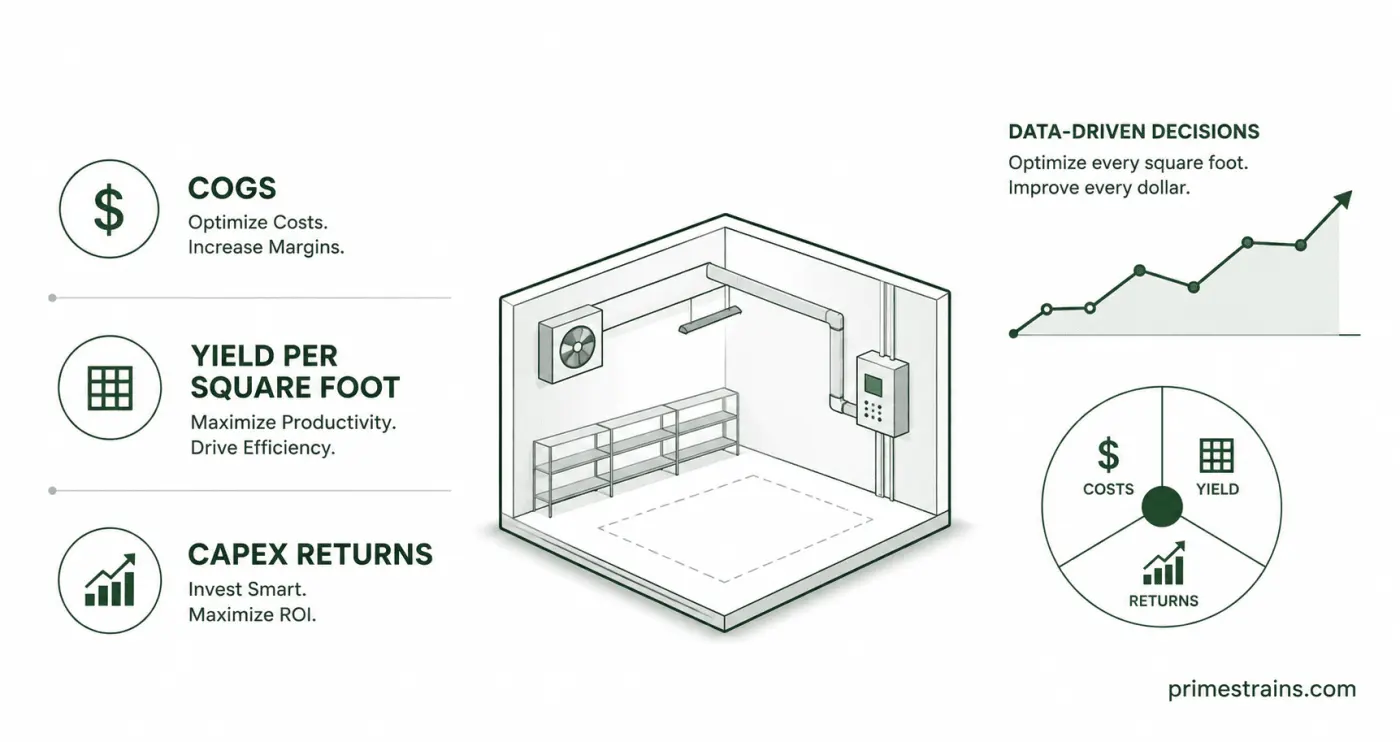
Key takeaways
- COGS Optimization Top-tier commercial facilities target a finished dry flower COGS below $150–$250 per pound ($0.33–$0.55 per gram), including direct labor, utilities, consumables, and facility overhead.
- Canopy Metric Benchmarks High-density LED facilities aim for an annual production benchmark of $100–$150 + dry grams per square foot of canopy space across 4 to 5 harvest cycles per year.
- Labor Overhead Dominance Direct manual labor (pruning, cloning, defoliation, and trimming) typically accounts for 40%–50% of total cultivation COGS, making task automation and ergonomic room design critical for margin protection.
- CapEx ROI Timelines Infrastructure investments—such as automated fertigation, multi-tier vertical racking, and energy-efficient LED fixtures—should demonstrate a clear payback window of 12 to 24 months through operational utility rebates or labor savings.
- Quality vs. Yield Balance Maximizing biomass output at the expense of cannabinoid percentage or terpene density reduces overall wholesale value per pound, making high secondary metabolite expression essential for premium flower pricing.
In an increasingly competitive global cannabis market characterized by wholesale price compression, driving operational efficiency is no longer optional—it is a core requirement for survival. Commercial success is defined by strict economic metrics: Cost of Goods Sold (COGS) per dry gram, usable flower yield per square foot, labor efficiency per pound, and Capital Expenditure (CapEx) payback velocity.
To maintain profitability, facility operators must align every cultivation decision—from lighting fixtures and genetics selection to automated post-harvest pipelines—with financial return models.
1. Deconstructing Commercial COGS per Gram
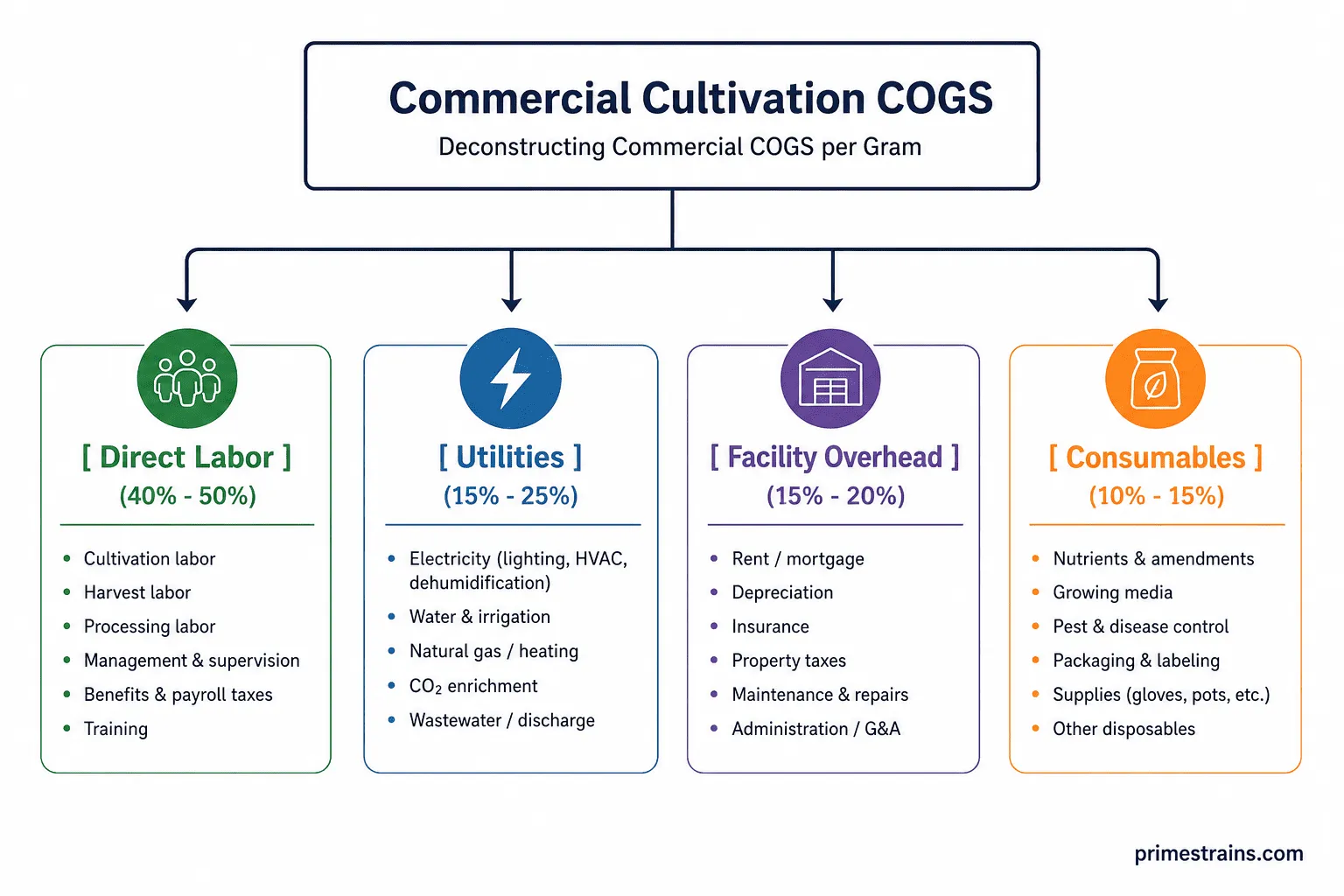
- Direct Labor: Includes room sanitation, propagation, transplanting, defoliation, harvest bucking, and hand trimming.
- Utilities (Power & Water): Driven primarily by high-PPFD LED arrays, HVACD climate balancing, and automated fertigation pumping systems.
- Facility Overhead: Fixed lease costs, property taxes, insurance, regulatory compliance licensing, and software management platforms (BMS/ERP).
- Consumables & Inputs: Substrates (rockwool/coco), mineral fertilizers, biosecurity inputs, packaging materials, and third-party laboratory testing fees.
2. Maximizing Yield and Revenue per Square Foot
The Math of Canopy Efficiency
- Single-Tier Standard: 50–60 g/sq. ft. per harvest x 4.5 harvests/year = 225–270 g/sq. ft./year
- Multi-Tier High-Density LED: 60–75+ g/sq. ft. per harvest per tier x harvests/year x 2 tiers = 540–675+ g/sq. ft./year
High-OpEx Traditional Facility vs. High-Efficiency Automated Facility
| Criteria | High-OpEx Traditional Facility | High-Efficiency Automated Facility |
|---|---|---|
| Average COGS per Dry Pound | 0 – 0+ (.88 – .32/g) | 0 – 0 (.33 – .55/g) |
| Annual Yield / Sq. Ft. Canopy | 0 – 0 grams 0 – 0+ grams (Multi-tier) | unknown |
| Trimming & Post-Harvest Cost | 0 – 0 per dry pound | – per dry pound (Automated) |
| Lighting Energy Efficiency | 1.7 umol/J (Legacy HPS) | 2.8 – 3.2+ umol/J (High-Efficacy LED) |
| Labor Hours per Dry Pound | 12 – 18 labor hours | 3 – 5 labor hours |
3. Financial Integration with Advanced Cultivation Protocols
- Microclimate Energy Balancing: Leverage facility automation, VPD management, and HVACD controls to optimize electrical efficiency and reduce total kWh consumption during lights-off periods.
- Eliminating Pathogen Crop Loss: Implement proactive commercial Integrated Pest Management (IPM) protocols and clean stock tissue culture programs to eliminate multi-million-dollar crop write-offs from Hop Latent Viroid (HLVd) or Botrytis.
- Standardizing Canopy Labor: Deploy True F1 hybrid seeds and systematic SCROG and canopy trellising protocols to streamline pruning tasks and ensure predictable, uniform harvest dates.
Frequently asked questions
What is the average payback period for converting an HPS flower room to LED?
Depending on regional utility electricity rates (kWh) and available energy provider rebates, converting from HPS to high-efficacy LEDs typically yields a full CapEx payback within 10 to 18 months through a 30%–45% reduction in electrical demand and lower HVAC cooling loads.
How does automated fertigation lower commercial COGS?
Automated crop steering systems deliver exact nutrient formulations and volumetric shot sizes based on substrate sensor feedback. This eliminates manual watering labor, reduces nutrient water waste by up to 30%, and ensures optimal root-zone conditions that maximize crop yield per square foot.
Is hand trimming worth the additional labor cost compared to machine trimming?
For top-shelf, high-margin boutique flower sold into retail dispensaries, hand trimming preserves outer trichome head integrity, commanding a price premium that justifies the higher labor cost ($100–$150/lb). For extraction-grade flower, pre-roll material, or wholesale biomass, automated mechanical trimming drastically cuts labor costs ($30–$50/lb) to protect bottom-line margins.
Authoritative sources
References supporting factual claims and further reading in this guide.