Yield Optimization & Canopy Management: SCROG, Trellising, and Pruning Protocols for Mass Cultivation
Master commercial yield optimization using data-backed canopy management protocols. Learn how SCROG, strategic trellising, and scheduled pruning maximize PAR penetration and dry flower output.
Key takeaways
- Target Light Interception Effective canopy training ensures that 85% - 95% of delivered Photosynthetically Active Radiation (PAR) is intercepted by active top fan leaves rather than lost to lower stems or floor space.
- Microclimate Mitigation Strategic lollipoppening and defoliation reduce internal humidity spikes within dense canopies, preventing stagnant air pockets that favor Botrytis (bud rot) and powdery mildew.
- Sink-to-Source Energy Redirection Pruning non-productive lower sites during early flower redirects photosynthate sugars strictly into upper calyx development, eliminating low-grade biomass.
- Labor Standardization Implementing strict calendar-based canopy schedules (e.g., Day 14 and Day 21 defoliation) reduces labor variance and simplifies training across large cultivation teams.
- Mechanical Canopy Support Multi-level trellising supports heavy floral biomass, preventing stem breakage under high-intensity lighting (>1,000 umol/m2 /s PPFD) and maintaining uniform canopy height.
In commercial cannabis operations, yield potential is determined long before harvest day. While genetic selection sets the theoretical upper limit for cannabinoid synthesis and biomass, canopy architecture dictates actual light interception efficiency, airflow dynamics, and labor overhead.
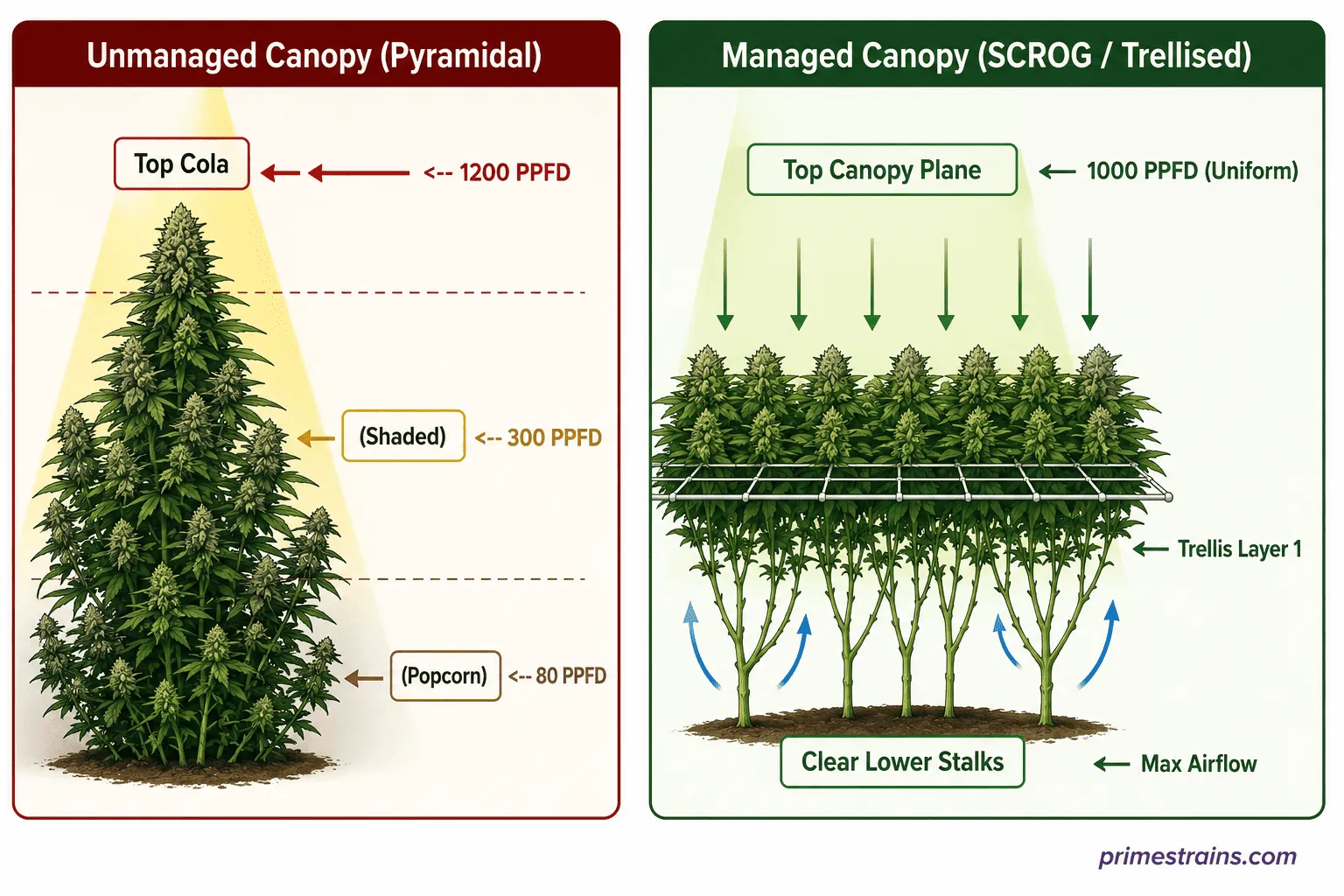
Leaving plant canopies unmanaged creates uneven light distribution, dense microclimates prone to fungal pathogens, and low-value larval or "popcorn" buds.
To achieve maximum output per square foot, canopy directors must execute systematic SCROG (Screen of Green), multi-tier trellising, and scheduled pruning protocols designed to convert raw PAR light into high-value top flower.
1. The Physics of Light Penetration and Canopy Architecture
2. Standard Operating Procedure: The 3-Phase Pruning & Training Timeline
Phase 1: Pre-Flower Canopy Shaping (Vegetative Week 3–4)
- Topping / FIMing: Remove the dominant apical shoot to break apical dominance and encourage lateral branch expansion.
- Bottom Lollipoppening (Lower 30%): Strip all micro-branches, leaves, and early shoots from the bottom third of the plant.
- Trellis Layer 1 Installation: Set the first grid net 8 - 12 inches above the container rim to weave expanding branches outwards.
Phase 2: The Day 21 Defoliation Pass (Transition Phase)
- Selective Leaf Removal: Remove large fan leaves that shade primary interior bud sites.
- Bud Site Reduction: Cull thin, weak tertiary branches that failed to reach the primary trellis level.
- Trellis Layer 2 Installation: Set the secondary support grid 12 - 18 inches above the first net to support late-stage flower weight.
Phase 3: The Day 42 Flush Pass (Ripening Phase)
- Airflow Clearance: Perform a light secondary defoliation to clear leaf mass blocking air circulation through dense floral clusters.
- Zero Upper Canopy Damage: Avoid heavy pruning past Day 45, as significant leaf removal late in flower can stall trichome synthesis and flower swelling.
Traditional Unmanaged Growth vs. Managed SCROG Canopies
| Criteria | Traditional Unmanaged Growth | Managed SCROG / Trellised Canopy |
|---|---|---|
| Canopy Profile | Natural Pyramidal | Flat / Horizontal Plane |
| Light Interception Efficiency | Poor (40% - 50% shaded out) | Maximum (85% - 95% PAR capture) |
| B-Grade "Popcorn" Bud Ratio | High (20% - 35% of total yield) | Minimal ( |
| Pathogen / Rot Risk | High (Trapped humidity pockets) | Low (Optimized boundary layer airflow) |
| Trimming Labor Overhead | High (Time spent processing small buds) | Low (Uniform, high-density top colas) |
3. Integrating Canopy Management with Next-Gen Genetics
- Uniform Growth Profiles: Running True F1 hybrid seeds ensures that every plant responds identically to pruning schedules, eliminating uneven growth stretches in the trellis.
- Disease Prevention Synergy: Pair aggressive defoliation with pathogen-free clean stock programs to maintain pristine microclimates that prevent systemic viroids and fungi from taking hold.
- Pollen-Free Density: Utilizing seedless triploid genetics allows growers to build ultra-dense canopies without worrying about accidental stress-induced seeds destroying crop value.
Frequently asked questions
What is the difference between SCROG (Screen of Green) and SOG (Sea of Green)?
SCROG uses a small number of larger plants trained horizontally across a wire mesh or trellis net to create a flat canopy. SOG uses a high density of small, un-topped plants grown closely together, moving them into flower quickly to harvest a single main cola per plant.
How much leaf mass can be safely removed during the Day 21 defoliation?
In commercial operations, removing 20% - 30% of the dense fan foliage on Day 21 is standard. Removing too much leaf area can stunt photosynthetic capacity, while removing too little fails to improve airflow and interior light penetration.
Does heavy pruning reduce overall plant biomass yield?
When executed correctly, pruning weak lower sites redirects metabolic energy upward, slightly reducing total wet biomass but significantly increasing usable, top-grade dry flower weight.
Authoritative sources
References supporting factual claims and further reading in this guide.