Triploid Cannabis & Polyploidy: Scaling Seedless, Pollen-Immune Canopies
Explore the science of triploid cannabis and polyploidy for commercial scaling. Learn how seedless 3n genetics prevent accidental pollination, boost cannabinoid yields, and lower labor costs.
Key takeaways
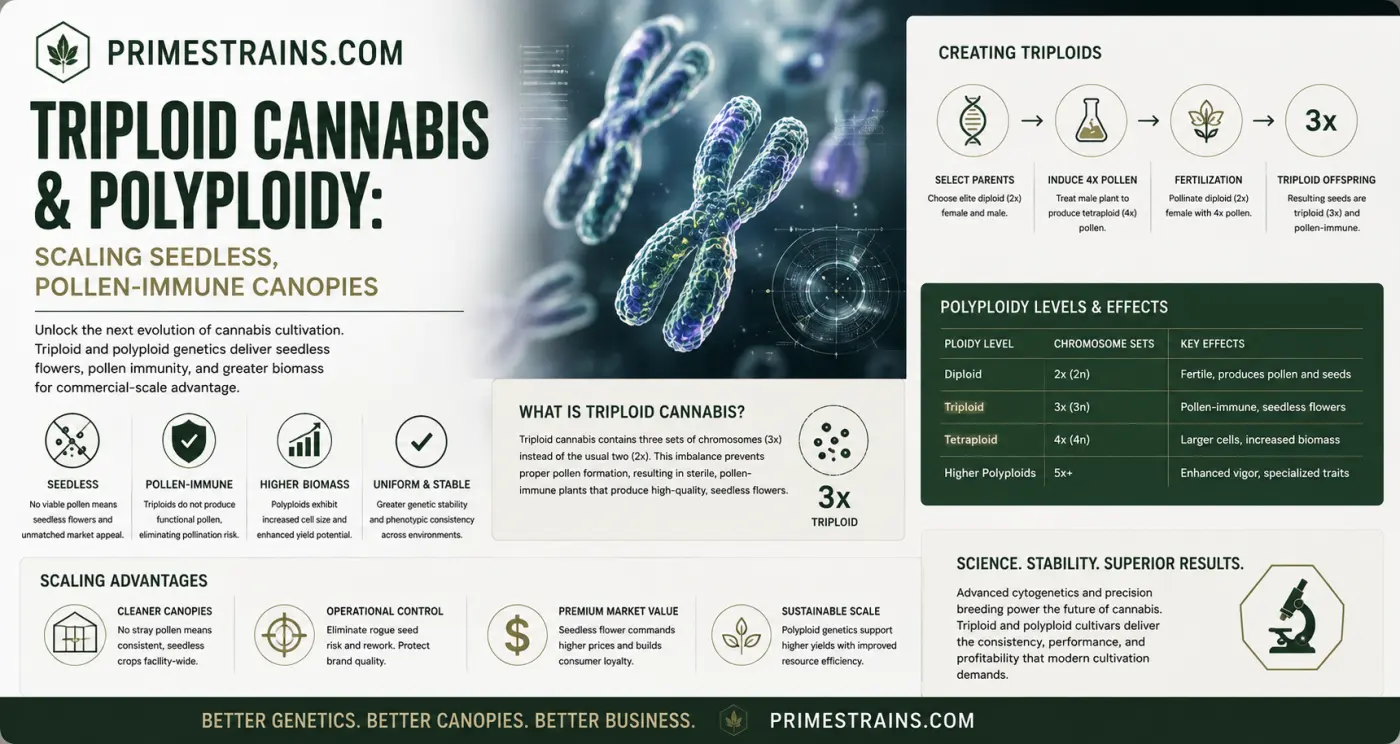
- Complete Pollen Immunity Triploid (3n) plants possess three sets of chromosomes, rendering them genetically infertile and incapable of forming seeds even when exposed to direct male pollen.
- Higher Cannabinoid Output Because triploid flowers direct zero metabolic energy toward seed development, plants allocate maximum carbohydrate resources into trichome synthesis, yielding higher total cannabinoids and terpenes.
- Polyploid Vigor Triploids display increased leaf area, thicker stem architecture, and accelerated biomass production during the vegetative phase compared to traditional diploid (2n) plants.
- Risk Mitigation for Outdoor/Greenhouse Canopies Commercial outdoor and greenhouse facilities operating near industrial hemp farms eliminate the threat of cross-pollination by deploying 100% triploid crops.
- Faster Flowering Cycles Select triploid cultivars demonstrate shorter flower maturing windows by 3 to 7 days, allowing commercial facilities to execute extra crop turns per year.
Accidental crop pollination is one of the single most expensive risks facing commercial cannabis facilities. Whether caused by stray outdoor pollen traveling miles, a undetected hermaphroditic plant in a dense canopy, or light leaks causing late-stage stress, unwanted seed formation degrades flower quality, destroys biomass value, and ruins solventless extract runs.
Triploid cannabis (3n) eliminates this risk entirely.
By leveraging polyploid breeding techniques long used in commercial agriculture (such as seedless watermelons and bananas), triploid genetics produce completely infertile, seedless plants with increased vegetative vigor, enhanced terpene density, and maximum cannabinoid yields.
1. The Genetics Behind Triploid Cannabis
Standard cannabis plants are diploids (2n), possessing two sets of 10 chromosomes (2n = 20). During standard sexual reproduction, each parent contributes 10 chromosomes to form a normal seed.
Triploid cannabis (3n) is created by crossing a chemically induced tetraploid (4n = 40) parent line with a standard diploid (2n = 20) parent line.
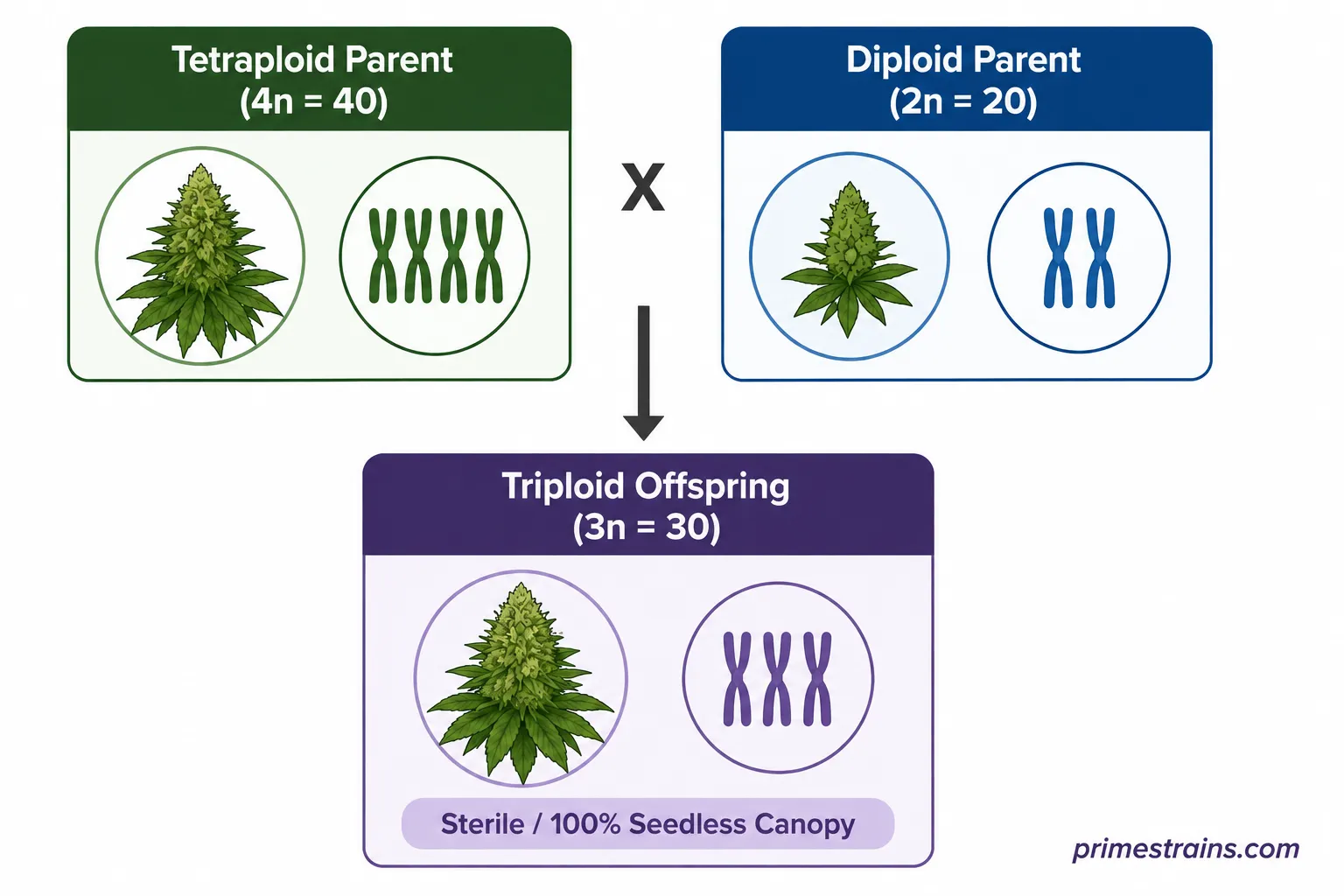
Because triploids contain an odd number of chromosome sets (3n = 30), their cellular machinery cannot successfully divide chromosomes during meiosis. As a result:
- Ovules cannot mature into viable seeds.
- Male pollen touching triploid pistils fails to fertilize the plant.
- Flower growth continues uninterrupted without metabolic slowdown.
2. Commercial Advantages of Seedless 3n Canopies
1. Protection Against Pollen Drift & Hermaphroditism
2. Metabolic Energy Redirection
3. Superior Biomass & Trichome Density
Diploid (2n) vs. Triploid (3n)
| Criteria | Standard Diploid (2n) | Advanced Triploid (3n) |
|---|---|---|
| Chromosome Count | 2n = 20 (Two sets) | 3n = 30 (Three sets) |
| Pollen Sensitivity | High (Forms seeds upon contact) | Zero (100% Sterile & Seedless) |
| Hermaphrodite Risk | High (Produces seeded flower under stress) | Zero Seed Risk (Flowers remain seedless) |
| Cannabinoid Potential | Standard Baseline | +10% to +20% Increase |
| Biomass Accumulation | Standard Rate | Accelerated (Larger cell volume / gigas effect) |
| Biosecurity Value | Moderate | Maximum (Ideal for outdoor & greenhouse) |
Integrating Triploids into Your Canopy Strategy
- Direct Seed Scaling: Start with feminised triploid seeds for uniform direct-seeding without male identification labor.
- Biosecurity Assurance: Combine triploids with pathogen-free propagation protocols to protect canopies from both viroids and seed contamination.
- Data-Driven Selection: Apply pheno-hunting protocols across triploid populations to identify elite 3n mothers for long-term production.
Frequently asked questions
Is triploid cannabis genetically modified (GMO)?
No. Triploids are not GMOs. Polyploidy occurs naturally in nature and is induced in breeding through natural plant cell selection techniques, identical to how seedless watermelons, grapes, and bananas were developed.
Can triploid plants produce pollen or seeds?
No. Triploid plants are genetically sterile. They cannot produce viable pollen or set seeds, even if exposed to heavy male pollen loads in outdoor farming conditions.
Do triploid seeds require different nutrient regimens?
No. Triploid cultivars grow exceptionally well under standard commercial fertigation schedules. Due to their increased vegetative vigor, some cultivars benefit from slightly higher early-stage calcium and nitrogen inputs during peak vegetative growth.
Authoritative sources
References supporting factual claims and further reading in this guide.