Indica vs Sativa Plant: Leaves, Growth and Key Differences
Compare indica and sativa plant appearance, from leaflets and branching to flowering labels. Learn what hybrid plants and genetics research can—and cannot—tell you before choosing seeds.
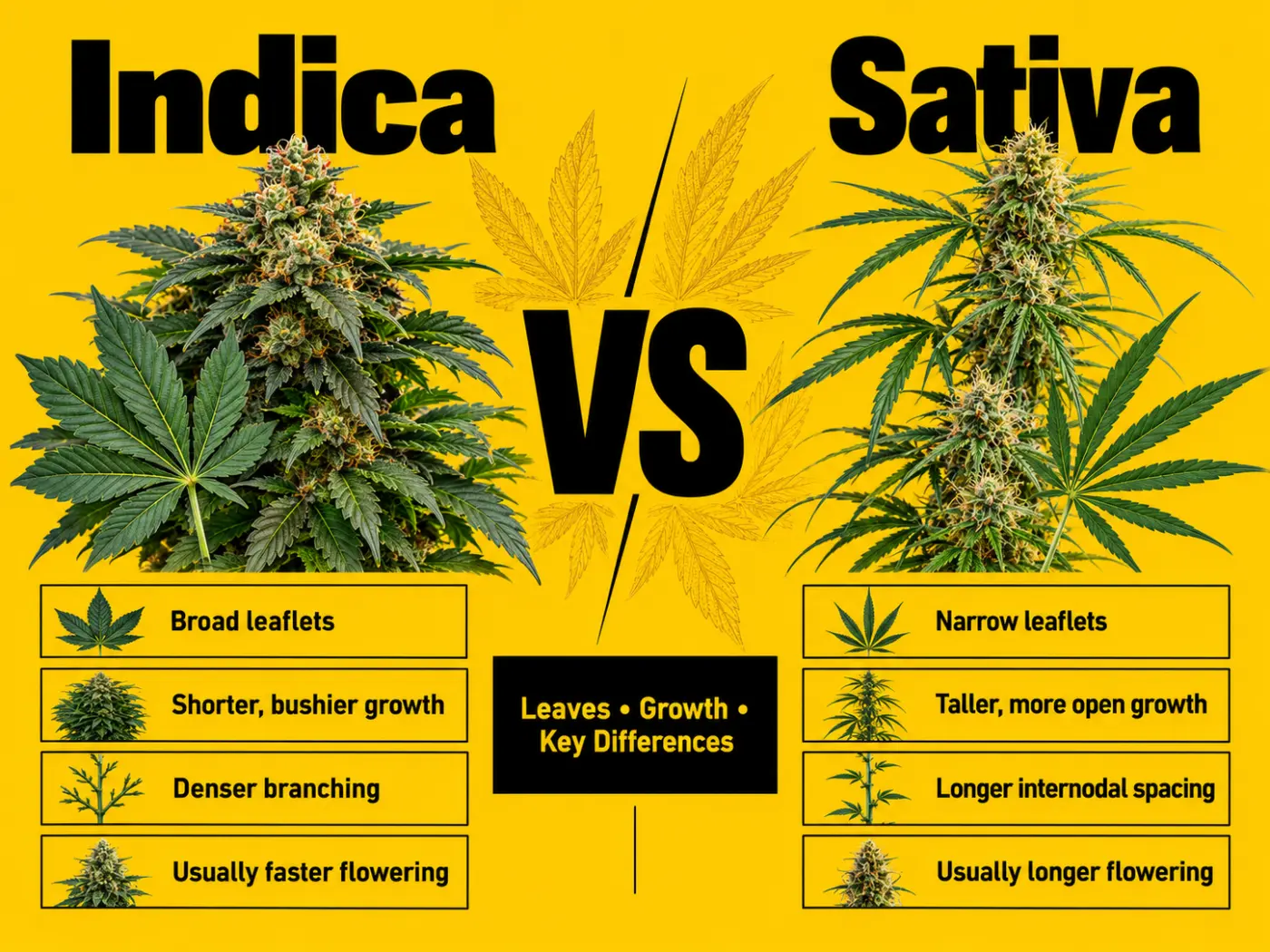
An indica vs sativa plant comparison usually begins with shape: broad or narrow leaflets, compact or open branching, and shorter or taller growth. Those are useful observations, but they are not a reliable test of a modern hybrid's ancestry, potency or effects.
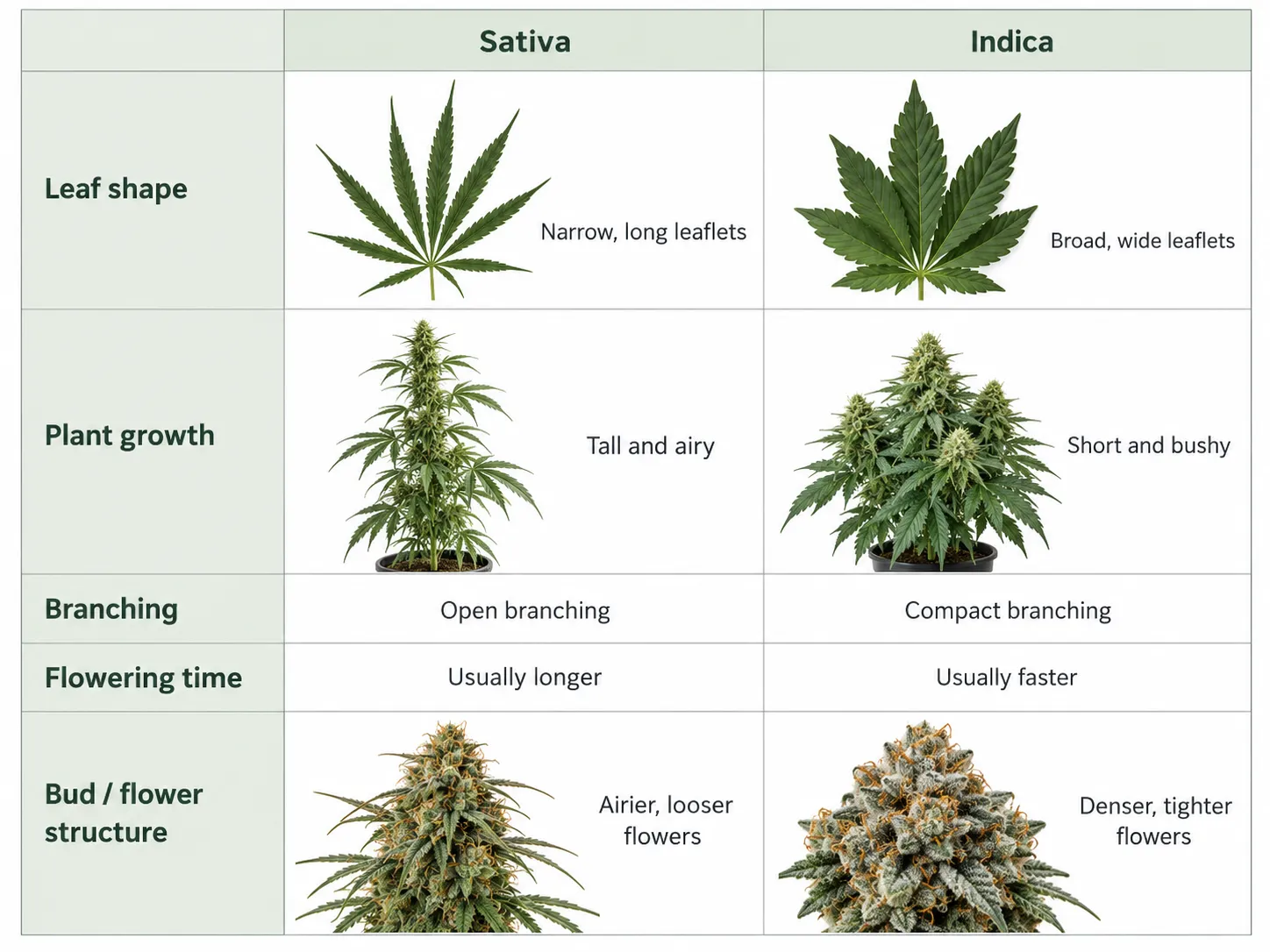
The practical approach is to describe the plant you can observe, then check the exact breeder and cultivar for the information you cannot see. This guide separates familiar visual tendencies from verified identification, and explains which details matter when comparing seed packs.
Indica vs sativa plants: the quick answer
In everyday seed-catalogue language, indica commonly describes a relatively compact, broad-leaflet plant, while sativa commonly describes a taller plant with narrower leaflets and more open spacing between branches. Modern hybrids can combine these features. A broad leaf does not prove that a plant is a pure indica, and a narrow leaf does not establish a particular effect.
Read the comparison below as a guide to descriptive tendencies, not as a diagnostic key. Neither column is a promise about every seed carrying that label.
| What you compare | Common indica-associated description | Common sativa-associated description |
|---|---|---|
| Leaflet shape | Relatively broad leaflets | Relatively narrow, elongated leaflets |
| Overall structure | Compact, densely branched appearance | Taller, more open appearance |
| Spacing along stems | Often described as shorter between nodes | Often described as longer between nodes |
| Flowering behaviour | Often marketed as earlier finishing | Often marketed as longer flowering |
| What still needs checking | Exact cultivar size, timing and seed format | Exact cultivar size, timing and seed format |
| What appearance cannot establish | THC/CBD content, genetic purity or individual effects | THC/CBD content, genetic purity or individual effects |
Look at leaflets, not just the leaf silhouette
The familiar cannabis fan leaf is made up of several leaflets. When someone describes an indica leaf as broad or a sativa leaf as narrow, they usually mean the width and proportions of those individual leaflets.
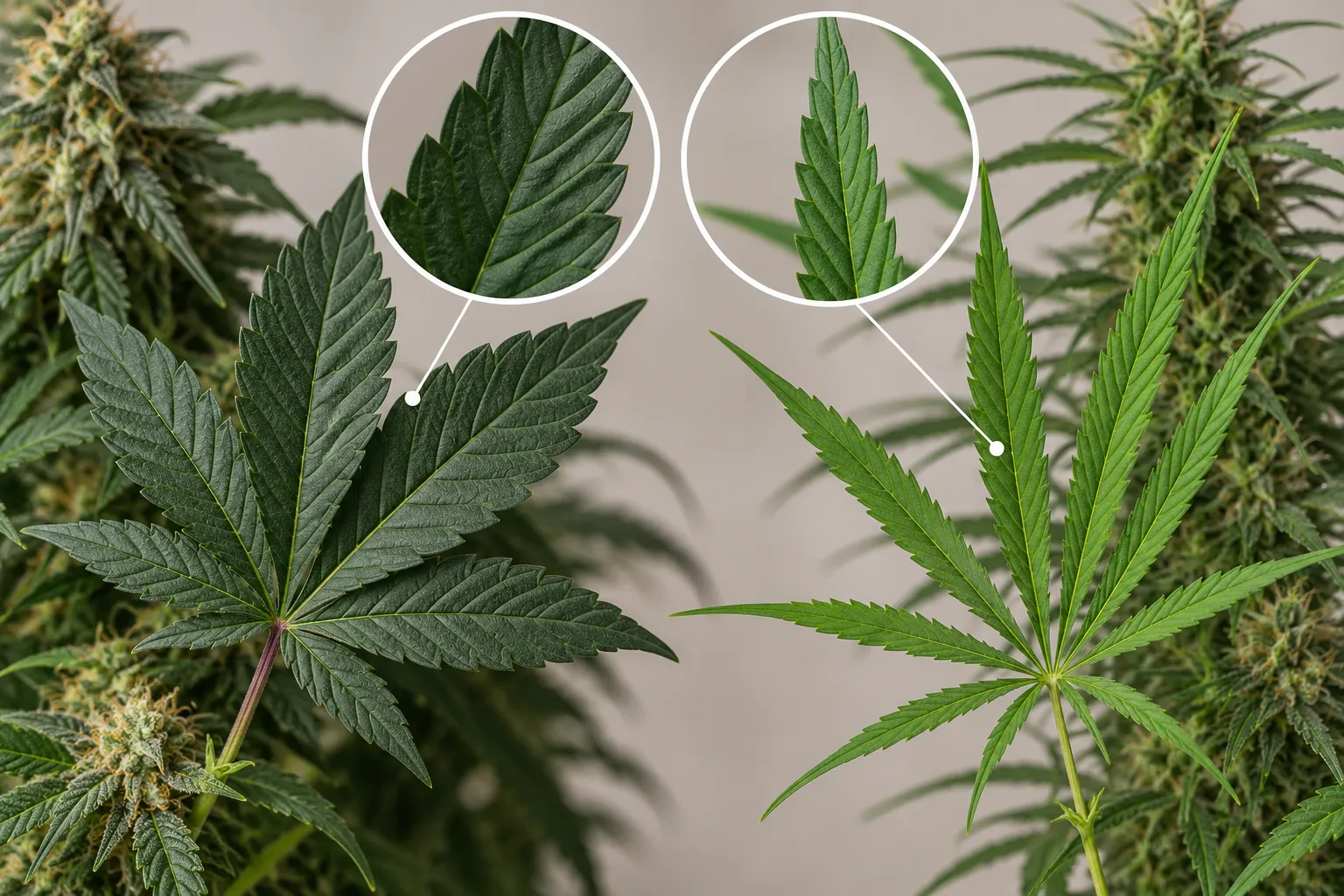
For a useful comparison, photograph several mature, healthy fan leaves rather than selecting one unusual leaf. Note whether the photographed plants are at comparable stages. A close-up can document the shape you observed; it cannot authenticate the seed label or reveal the plant's cannabinoid content.
Leaflet count is not a dependable shortcut to an indica/sativa percentage. Avoid captions such as “seven fingers proves sativa” or “wide leaves guarantee a relaxing effect”. Describe what the image actually shows: relatively broad or narrow leaflets, with cultivar identity stated only when its provenance is known.
Compare plant structure and flowering separately
Whole-plant photographs add context that a detached leaf cannot provide. Look at branching, the distance between successive nodes and the relationship between height and canopy width. Record whether the plant has been trained: a shaped canopy is not a neutral illustration of its unmodified growth habit.
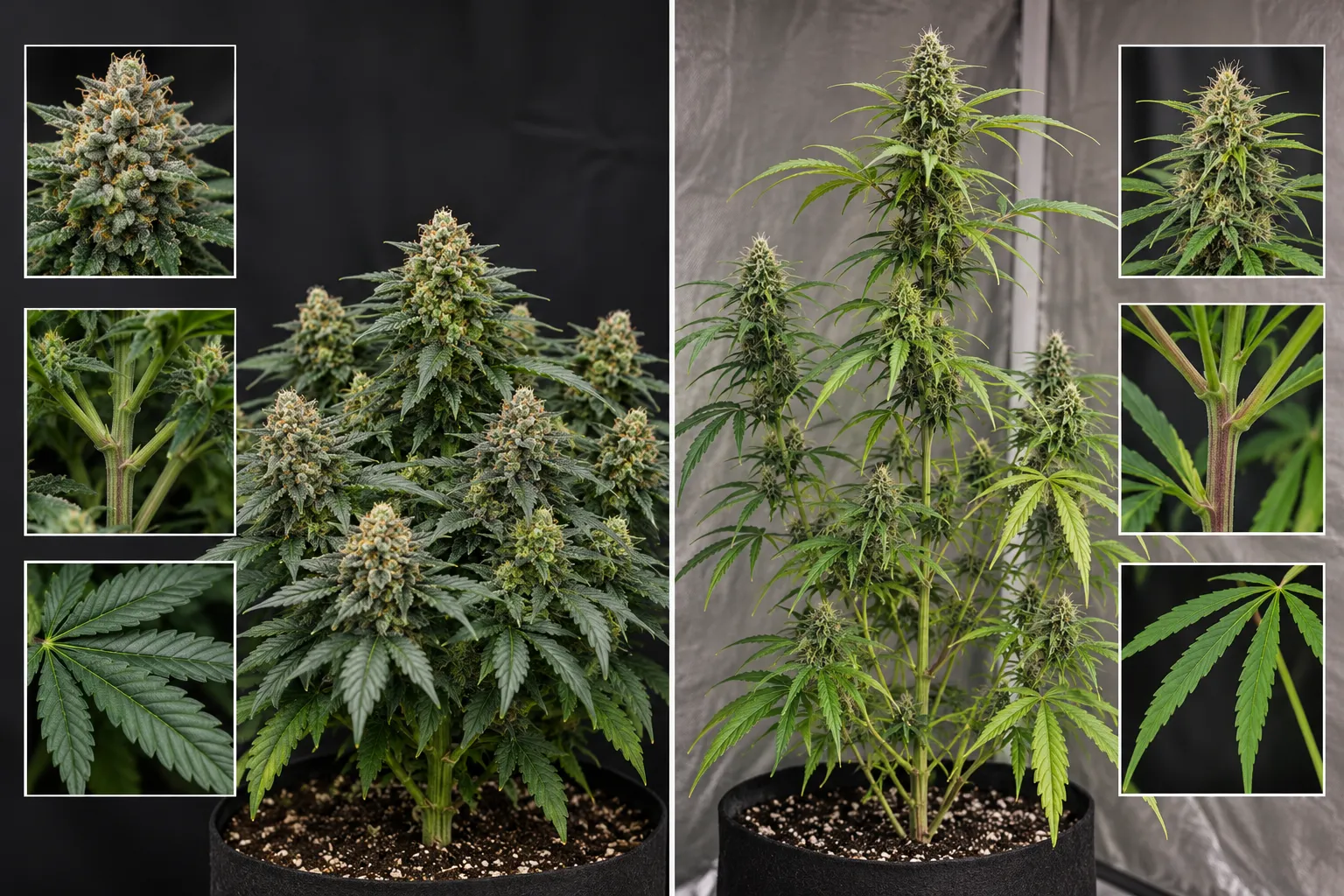
Traditional breeder guides associate compact forms with indica and taller, more open forms with sativa. Treat that as a starting description. For a specific pack, compare the breeder's stated indoor and outdoor dimensions, the conditions behind those estimates, and any cultivar-specific notes about stretch.
Do not plan from a universal rule such as “every sativa triples in height”. If the breeder gives no supported stretch estimate for the exact cultivar, record that uncertainty instead of substituting a number from another strain.
Flowering time is not the entire lifecycle
“Flowering time” and “seed to harvest” describe different intervals. Before comparing two advertised durations, check where each clock starts. A photoperiod cultivar's flowering estimate does not include all the time before flowering. An autoflower listing may instead state an estimated complete lifecycle.
Keep the indica/sativa description separate from flowering behaviour. An indica-labelled cultivar may be photoperiod or autoflowering; so may a sativa-labelled one. Our cannabis growing-stages guide explains these timing labels, while the autoflower seed category is the place to compare automatic-flowering products.
Why a hybrid can look like both
Hybrid labels make a simple two-picture identification chart less decisive. A plant may have broad leaflets alongside an open branching pattern, or a compact overall shape that does not match the familiar sativa illustration. Describe the combination rather than forcing it into a pure category.
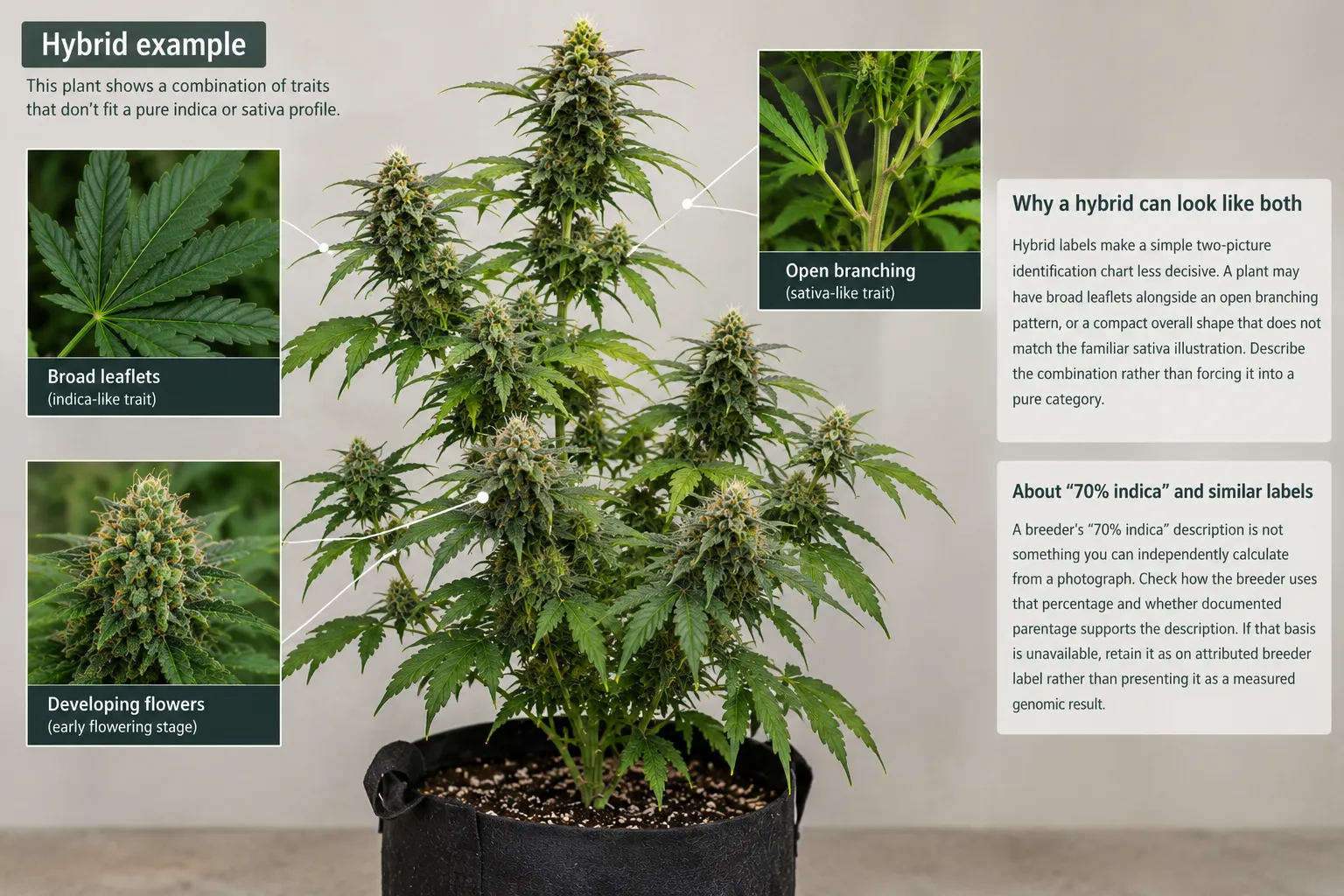
A breeder's “70% indica” description is not something you can independently calculate from a photograph. Check how the breeder uses that percentage and whether documented parentage supports the description. If that basis is unavailable, retain it as an attributed breeder label rather than presenting it as a measured genomic result.
What genetics research says about the labels
In a 2021 study of more than 100 samples, Watts and colleagues found that sativa- and indica-labelled samples did not separate clearly across the genome. The labels were associated with some terpene variation. That is not a finding that every cannabis plant is identical, or that a terpene measurement guarantees a particular experience.
Sawler and colleagues' 2015 study also found that reported strain ancestry only partly captured the genetic structure of the sampled material. These are studies of particular sample sets, not genetic certification of every current retail seed pack.
Botanical naming is another layer. Kew's Plants of the World Online treats Cannabis sativa var. indica as a synonym of Cannabis sativa. That taxonomic treatment should not be confused with the everyday labels printed in a seed catalogue. A useful article can explain both without pretending they are interchangeable systems.
Can you tell strength or effects from the plant?
No reliable strength or personal-effect conclusion follows from broad leaves, narrow leaves or plant height alone. A catalogue's indica/sativa classification is not a laboratory result. Where chemical composition matters, look for relevant testing and its sample identity rather than converting an appearance label into a THC or CBD estimate.
This guide does not recommend indica or sativa for treating a condition. It also does not replace the familiar “indica relaxes, sativa energises” shortcut with an equally absolute claim about individual terpenes. For terminology, see our terpene directory; use named compounds as information to investigate, not a guaranteed outcome.
A better checklist for comparing seed packs
- Match the identity. Record the breeder, exact cultivar name and product reference. Similar names from different breeders do not establish identical genetics.
- Check the seed format. Feminised or regular describes a different choice from indica or sativa. Compare feminised seeds and regular seeds on their own terms.
- Check flowering behaviour. Confirm photoperiod or autoflower, then compare durations with the same starting point.
- Look for relevant dimensions. Prefer cultivar-specific height and structure information to a generic silhouette.
- Keep missing evidence visible. An absent source is a reason to ask the breeder, not permission to borrow another product's specification.
- Compare the pack itself. Check seeds per pack, selected-pack price and current availability separately from the plant description.
If you are choosing among catalogue products, use the cannabis strain finder to narrow the options, then open each product's breeder and pack details. Its stored attributes help organise a shortlist; they do not independently validate every breeder claim.
How to read an indica vs sativa plant picture
A helpful comparison image should identify what is being compared: leaflets, a whole plant or flowers. Check the caption for cultivar, stage and whether pruning or training changed the outline. If those details are unknown, the picture is illustrative rather than proof of a genetic distinction.
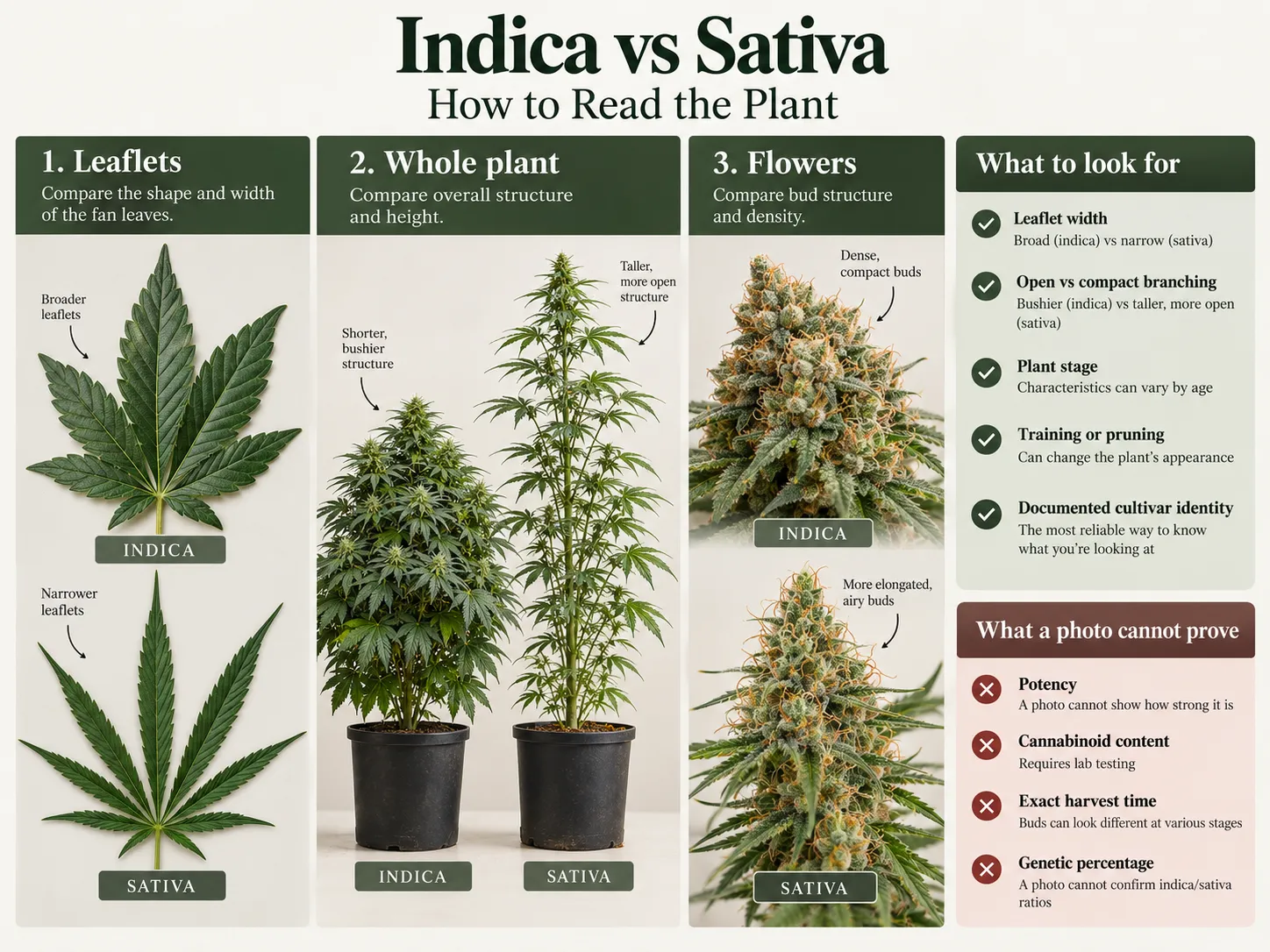
Use the photograph to ask better questions: Is the branching open or compact? Are the leaflets relatively narrow or broad? Is the claimed identity documented? Keep those observations separate from conclusions about potency, harvest date or suitability for your circumstances.
The practical takeaway
Indica and sativa remain familiar descriptions, but a seed choice deserves more than a label. Start with visible traits, confirm the exact cultivar, and compare the evidence behind its size, flowering behaviour and pack format. That produces a more useful comparison than assigning a guaranteed outcome to a leaf shape.
Frequently asked questions
Can you identify indica or sativa from a leaf?
Leaflet shape can suggest a familiar broad-leaf or narrow-leaf description, but it cannot authenticate a modern hybrid’s ancestry, cannabinoid content or effects. Check the exact cultivar and breeder information.
Are indica plants always shorter than sativa plants?
No. Shorter and taller growth are common catalogue tendencies, not universal limits. Check cultivar-specific size information and whether the photographed plant was trained.
Does indica or sativa tell you whether a plant is autoflowering?
No. Indica/sativa descriptions and photoperiod/autoflowering behaviour describe different characteristics. Confirm the seed format and flowering behaviour separately.
Is flowering time the same as seed to harvest?
No. A flowering estimate covers a different interval from a complete lifecycle estimate. Compare the starting point of each breeder’s stated duration.
Authoritative sources
References supporting factual claims and further reading in this guide.
- Cannabis labelling is associated with genetic variation in terpene synthase genes Watts et al., Nature Plants (2021) nature.com
- The Genetic Structure of Marijuana and Hemp Sawler et al., PLOS ONE (2015) journals.plos.org
- Cannabis sativa var. indica Kew Plants of the World Online powo.science.kew.org