Inbred Lines (IBLs) & True F1 Hybrids: The Science of Heterosis in Commercial Cannabis Breeding
Discover how Inbred Lines (IBLs) and True F1 Hybrids deliver genetic uniformity, heterosis (hybrid vigor), and predictable canopy yields for commercial cannabis operations.
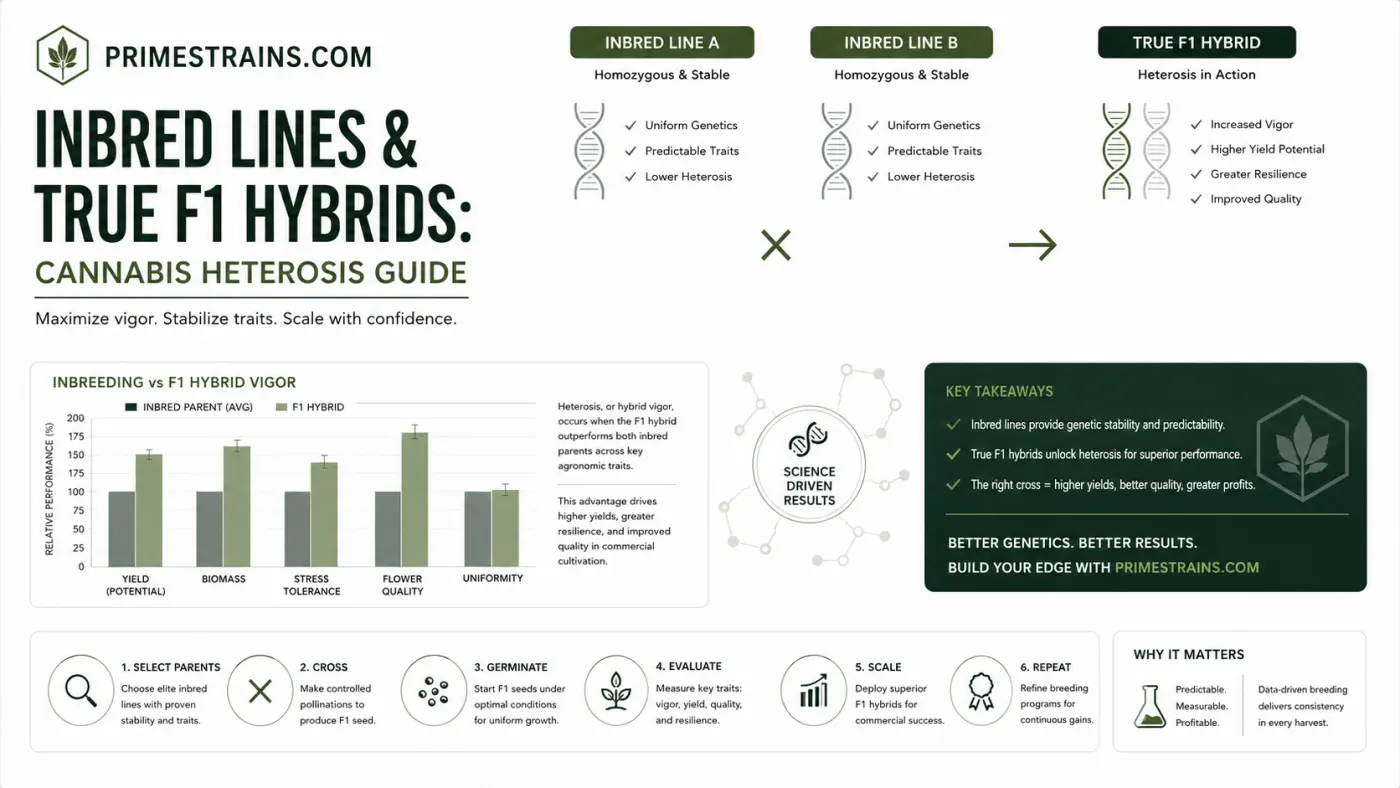
Key takeaways
- Genetic Homozygosity Inbred Lines (IBLs) are created through consecutive generations of selfing (S1, S2) or sibling mating, producing plants with identical alleles that breed true for target traits.
- Heterosis (Hybrid Vigor) Crossing two distinct, highly homozygous IBL parent lines creates a True F1 hybrid, yielding offspring with increased biomass, faster vegetative growth, and superior stress tolerance.
- Canopy Uniformity True F1 hybrid seed populations exhibit near 100% phenotype uniformity, allowing commercial operators to standardize fertigation, light intensity, and harvest timing.
- Polyhybrid Phenotypic Breakdown Standard polyhybrid seeds express wide genetic segregation (F2-like variation), leading to uneven canopy height, variable nutrient requirements, and inconsistent COA profiles.
- Scalable Seed-Based Production True F1 seeds enable large-scale facilities to bypass expensive clone nursery infrastructure without sacrificing crop consistency.
For decades, the commercial cannabis market has been dominated by polyhybrids—unstable crosses of two multi-generational hybrid parents. While polyhybrids produce high variation for pheno-hunting, they present major operational challenges for commercial cultivation managers who require predictable growth rates, uniform canopy heights, and consistent flowering times across thousands of square feet.
To achieve industrial agricultural consistency, commercial breeding is shifting toward Inbred Lines (IBLs) and True F1 Hybrids.
By developing highly homozygous parent lines and crossing them to trigger heterosis (hybrid vigor), seed producers can deliver seed populations that match the uniform performance of clones while eliminating nursery pathogen risks.
1. The Science of Inbred Lines (IBLs) and Homozygosity
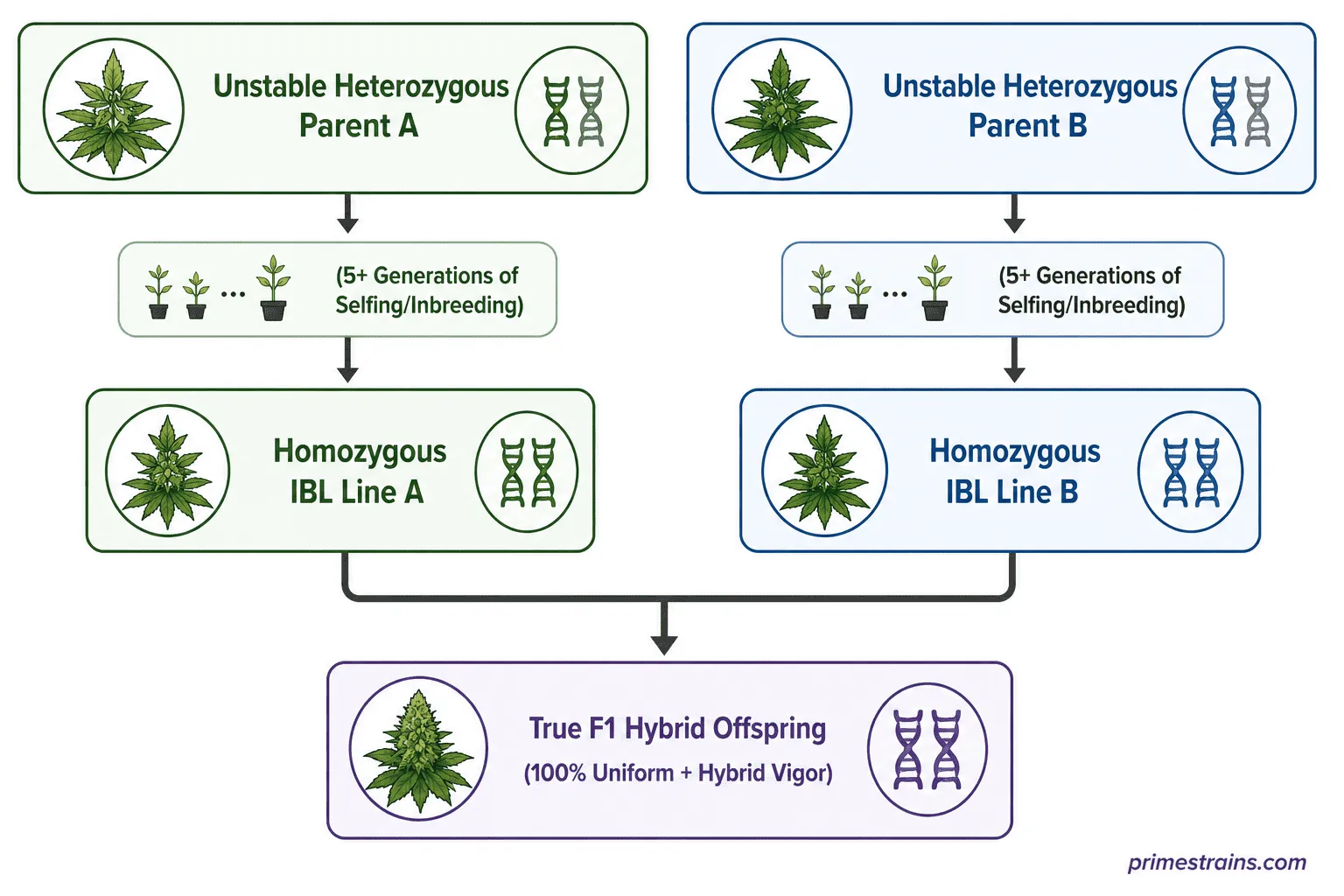
- It produces offspring that are genetically identical to the parent for selected traits (pest resistance, canopy structure, terpene profile).
- It serves as a predictable genetic building block for producing commercial F1 seed stock.
2. Exploiting Heterosis (Hybrid Vigor) in Canopy Operations
- Accelerated Rooting & Veg Vigor: True F1 seedlings establish root systems 20% - 30% faster than standard clone plugs or polyhybrids.
- Stress Resilience: Superior metabolic efficiency provides higher tolerance against thermal stress, transient humidity spikes, and light intensity changes.
- Biomass and Resin Accumulation: Heterotic plants exhibit increased photosynthetic capacity, driving higher dry flower weight per square foot and elevated trichome synthesis.
Polyhybrids vs. True F1 Hybrids
| Criteria | Standard Polyhybrid Seeds | True F1 Hybrid Seeds |
|---|---|---|
| Parental Background | Heterozygous x Heterozygous | Homozygous IBL x Homozygous IBL |
| Phenotypic Uniformity | Low (30% - 50% trait variation) | High (95% - 99% identical phenotype) |
| Hybrid Vigor (Heterosis) | Minimal to absent | Maximum Expression |
| Canopy Height Consistency | Variable (Requires extensive trellis work) | Uniform (Even canopy light interception) |
| Harvest Window Sync | Staggered over 7–14 days | Simultaneous (All plants mature on Day X) |
| Commercial Application | Genetic discovery / Pheno-hunting | Commercial Canopy Batching |
3. Integrating True F1 Seeds into Commercial Operations
- Bypassing Nursery Disease Vectors: Because seeds do not carry systemic pathogens like Hop Latent Viroid (HLVd), utilizing clean F1 seeds replaces traditional clone transport. Facilities can maintain pathogen-free operations by pairing seed protocols with clean stock tissue culture programs.
- Streamlining Genetic Selection: Instead of running massive 500-plant population hunts required for polyhybrids, commercial operators running data-driven pheno-hunting protocols can evaluate as few as 20 to 30 True F1 plants to confirm strain performance.
- Next-Gen Synergy: Combining True F1 hybrid breeding with seedless triploid technology enables breeders to produce high-performing, pollen-immune crops engineered specifically for large-scale commercial extraction and flower production.
Frequently asked questions
What is the difference between an F1 hybrid and an F2 hybrid?
An F1 hybrid is the first-generation cross between two distinct, homozygous inbred parent lines, resulting in uniform offspring with hybrid vigor. An F2 hybrid is created by crossing two F1 plants together, which causes genetic segregation and results in widespread variation in plant height, yield, potency, and structure.
Why are most commercial cannabis seeds polyhybrids instead of True F1 hybrids?
Developing true Inbred Lines (IBLs) requires 5 to 7 generations of controlled breeding and selfing (S1 - S5), taking years of work. Many seed markets historical relied on crossing two popular hybrid clones, producing polyhybrids rather than stabilized F1 seeds.
Do True F1 hybrid seeds eliminate the need for clone mother rooms?
Yes. Facilities running stabilized True F1 hybrid seeds can direct-seed into plug trays, achieving the canopy uniformity of clones without maintaining permanent mother spaces or risking systemic viroid accumulation.
Authoritative sources
References supporting factual claims and further reading in this guide.