F1 Hybrids vs. Inbred Lines (IBL) vs. Polyhybrids: Understanding Seed Stability
Master the science of cannabis seed stability. Learn the differences between True F1 Hybrids, Inbred Lines (IBL), and Polyhybrids, how heterosis drives canopy uniformity, and how to spot stable genetics.
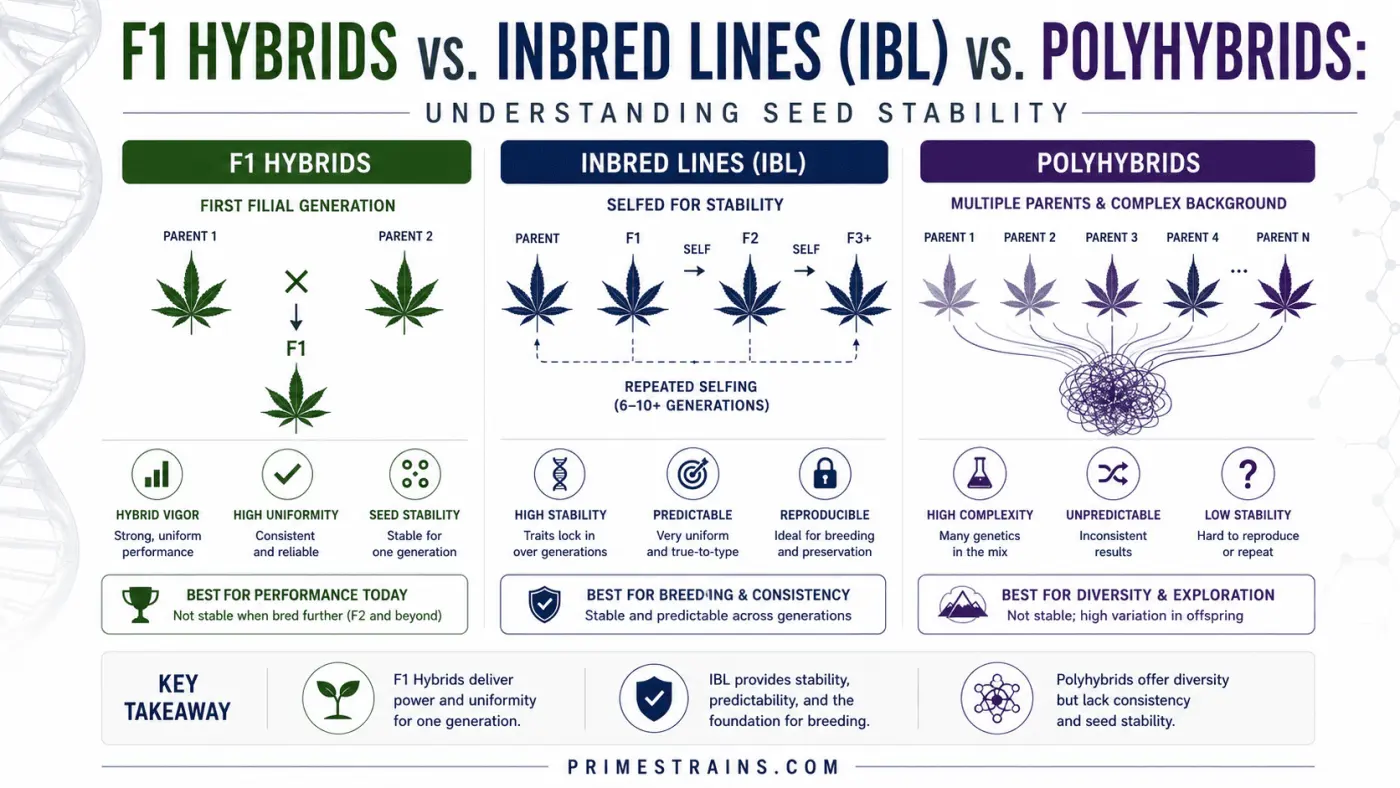
Key takeaways
- True F1 Hybrid Definition A Filial 1 (F1) hybrid is the first-generation offspring produced by crossing two distinctly different, highly stable Inbred Lines (IBL).
- Heterosis (Hybrid Vigor) True F1 hybrids exhibit heterosis, resulting in faster vegetative growth, higher stress resistance, elevated cannabinoid levels, and extreme phenotypic uniformity.
- Inbred Line (IBL) Definition An IBL is a cultivar that has been selfed or backcrossed over multiple generations (F5 - F8+) to stabilize specific genetic traits until offspring grow nearly identical to parents.
- F2 Genetic Segregation Crossing two F1 hybrids creates an F2 generation, which breaks down hybrid vigor and results in extreme phenotypic variation across seed batches.
- Polyhybrid Uniformity Standard retail polyhybrids lack the homozygous parent foundation needed for true F1 vigor, leading to diverse plant height, bud density, and harvest timelines.
For commercial canopy directors and serious home growers, unpredictable seed genetics are a major operational liability. Buying a pack of seeds only to discover ten completely different plant structures, flowering times, and nutrient requirements wastes space, time, and revenue.
While the modern seed market is flooded with popular strains labeled as "F1s," true genetic stability in cannabis requires rigorous plant breeding.
Understanding the differences between Inbred Lines (IBL), True F1 Hybrids, and standard Polyhybrids is essential for selecting seeds that deliver maximum yield, uniform growth, and predictable outcomes.
1. Inbred Lines (IBL):
The Genetic FoundationAn Inbred Line (IBL) is a strain that has been selectively self-pollinated or sibling-mated for at least five to eight generations (F5 - F8+).
Through continuous line-breeding, geneticists force the plant’s genome into a homozygous state. This means the alleles for key structural, chemical, and growth traits are identical across chromosome pairs.

Characteristics of Inbred Lines:
- Predictable Inheritance: Seed offspring grow nearly identical to their parents in structure, flowering speed, and aroma.
- Homozygosity: Eliminates hidden recessive traits, ensuring high stability.
- Inbreeding Depression: Over-inbreeding can cause reduced growth vigor, lower overall stress tolerance, and diminished yields compared to hybrids.
- Breeding Value: IBLs serve as the essential parent lines used to synthesize True F1 Hybrids. Historically, many IBLs were developed directly from stable ancestral landrace cannabis strains.
2. True F1 Hybrids: The Science of Heterosis

Advantages of True F1 Hybrids for Cultivators:
- Clone-Like Canopy Uniformity: Every plant in a True F1 seed batch grows to a similar height, develops identical node spacing, and finishes flowering within a tight 2-to-3-day window.
- Explosive Growth Vigor: Heterosis accelerates root development and vegetative growth, shortening cultivation cycles.
- Enhanced Stress Tolerance: Greater resilience to temperature swings, drought, and pest pressures.
- Maximized Yield & Potency: Yield gains and cannabinoid levels routinely surpass both parent IBL lines.
3. Polyhybrids & The F2 Trap: Why Most Retail Seeds Vary
Why Polyhybrids Cause Canopy Variance:
- Genetic Segregation: Dominant and recessive traits recombine randomly, producing high plant-to-plant variation.
- Pheno-Hunting Required: A 100-seed batch of polyhybrids may yield dozens of distinct plant structures, requiring growers to select and clone a single "keeper."
- Inconsistent Harvest Schedules: Plants within the same grow tent may finish flowering anywhere between 7 and 10+ weeks.
True F1 Hybrids vs. Standard Polyhybrids
| Criteria | True F1 Hybrid (IBL A x IBL B) | Standard Polyhybrid (Hybrid x Hybrid) |
|---|---|---|
| Parental Background | Two distinct, highly inbred lines (IBLs) | Two complex, multi-crossed hybrid lines |
| Genetic State | Uniformly Heterozygous | Highly Segregated / Variable |
| Canopy Uniformity | Extreme (Clone-like growth from seed) | Low to Moderate (High phenotypic variance) |
| Growth Vigor | High (Unlocks true heterosis) | Standard (Varies by individual phenotype) |
| Flowering Window | Extremely tight (1–3 day harvest spread) | Wide spread (7–14 day harvest spread) |
| Stress Vigor | High disease & climate resilience | Variable pest & disease susceptibility |
| Primary Use Case | Commercial canopy efficiency & scale | Pheno-hunting & boutique variety |
How to Spot True F1 Hybrid Seeds vs. Marketing Hype
- Ask for Parent Line Transparency: Reputable F1 breeders disclose the inbred parent stock (S5+IBL) used to create the cross.
- Look for Uniformity Guarantees: True F1 hybrids demonstrate consistent canopy height and structural traits across field-trial testing data.
- Beware of Trend-Chasing Crosses: Hyped strain-on-strain crosses (Strain A x Strain B) are almost always polyhybrids, not true F1 hybrids.
The Future of Commercial Seed Production
As commercial cannabis scales, facility efficiency depends on standardization. By combining the genetics of stabilized Inbred Lines with modern breeding innovations like triploid polyploidy, breeders are providing commercial cultivators with true F1 hybrid seeds that outperform legacy clones in vigor, potency, and disease resistance.Authoritative sources
References supporting factual claims and further reading in this guide.