Clean Stock Management: Tissue Culture & Micropropagation Protocols for Canopy Biosecurity
Learn how commercial cannabis operations use tissue culture and micropropagation to eliminate pathogens like HLVd, preserve elite genetics, and scale clean nursery stock.
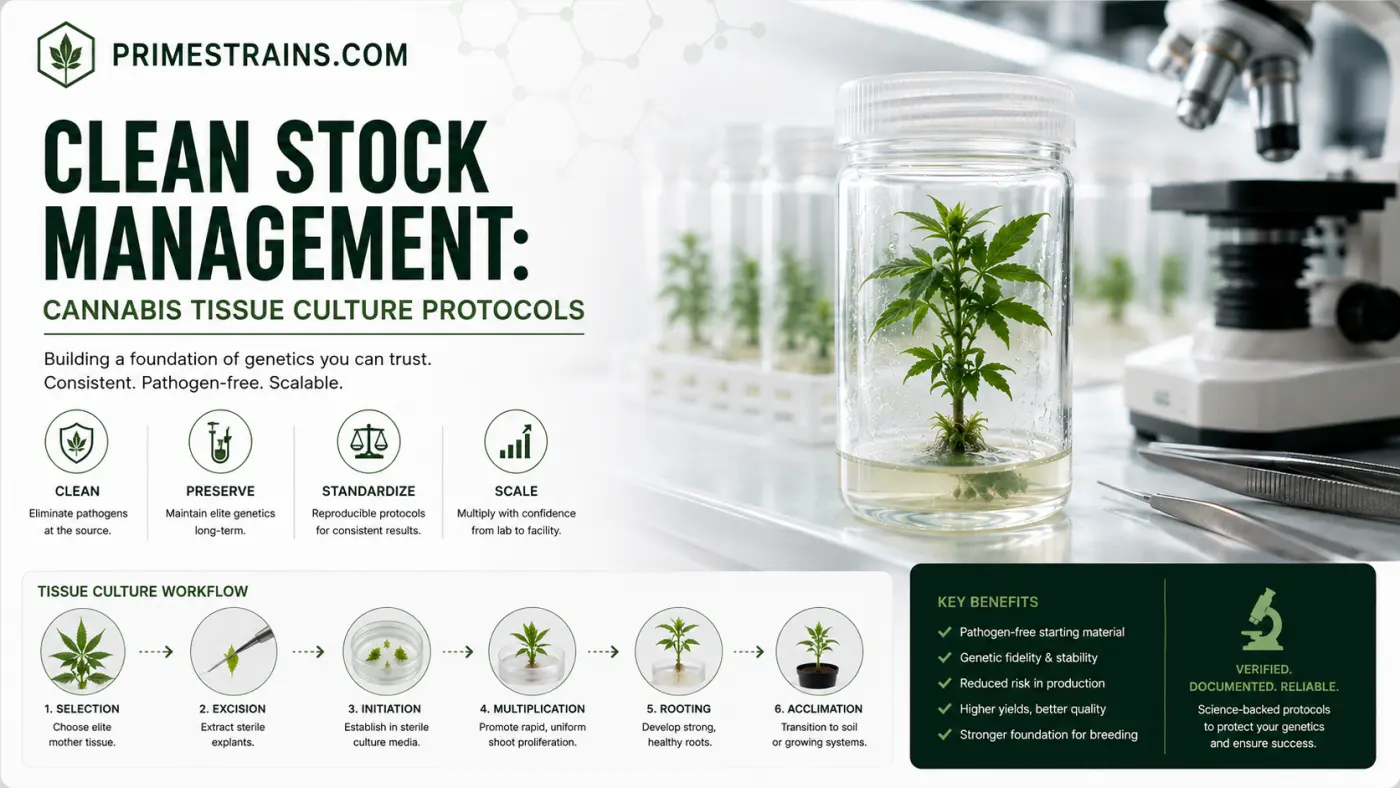
Key takeaways
- Meristem Remediation Efficacy Meristematic tissue culture—excising the microscopic apical dome of a growing shoot—physically excludes systemic viroids like HLVd, producing 100% pathogen-cleared plants.
- Massive Footprint Reduction A single multi-tier in vitro tissue culture rack holding vessels can replace up to 2,000 sq. ft. of traditional commercial mother room canopy space.
- Vigor Restoration Plants regenerated from micropropagation exhibit renewed vegetative vigor, improved rooting speed, and uniform canopy structure comparable to fresh seedling stocks.
- Zero Pest Vectoring Tissue culture plantlets are rooted in sterile agar/gellanth media inside sealed containers, completely eliminating insect vectors (such as fungus gnats and root aphids) during nursery transport.
- Long-Term Genetic Preservation Cold-storage micropropagation allows facilities to bank elite phenotypes indefinitely without the labor, lighting, or nutrient costs of continuous mother plant maintenance.
In modern commercial cannabis production, systemic pathogens—most notably Hop Latent Viroid (HLVd), Pythium, and Fusarium—represent a multi-million-dollar threat to canopy health and financial viability. Traditional clone propagation continuously passes systemic infections from mother plants to root zone cuts, leading to "dudding," reduced terpene expression, and yield collapses of up to 50%.
To insulate facilities from catastrophic crop failures, leading operators are shifting from standard mother rooms to Clean Stock Programs driven by tissue culture (micropropagation).
By leveraging meristem remediation and sterile in vitro banking, commercial facilities can completely scrub pathogens from infected genetics, maintain genetic integrity indefinitely, and rapidly scale clean plantlets on demand.
1. The Science of Meristem Remediation
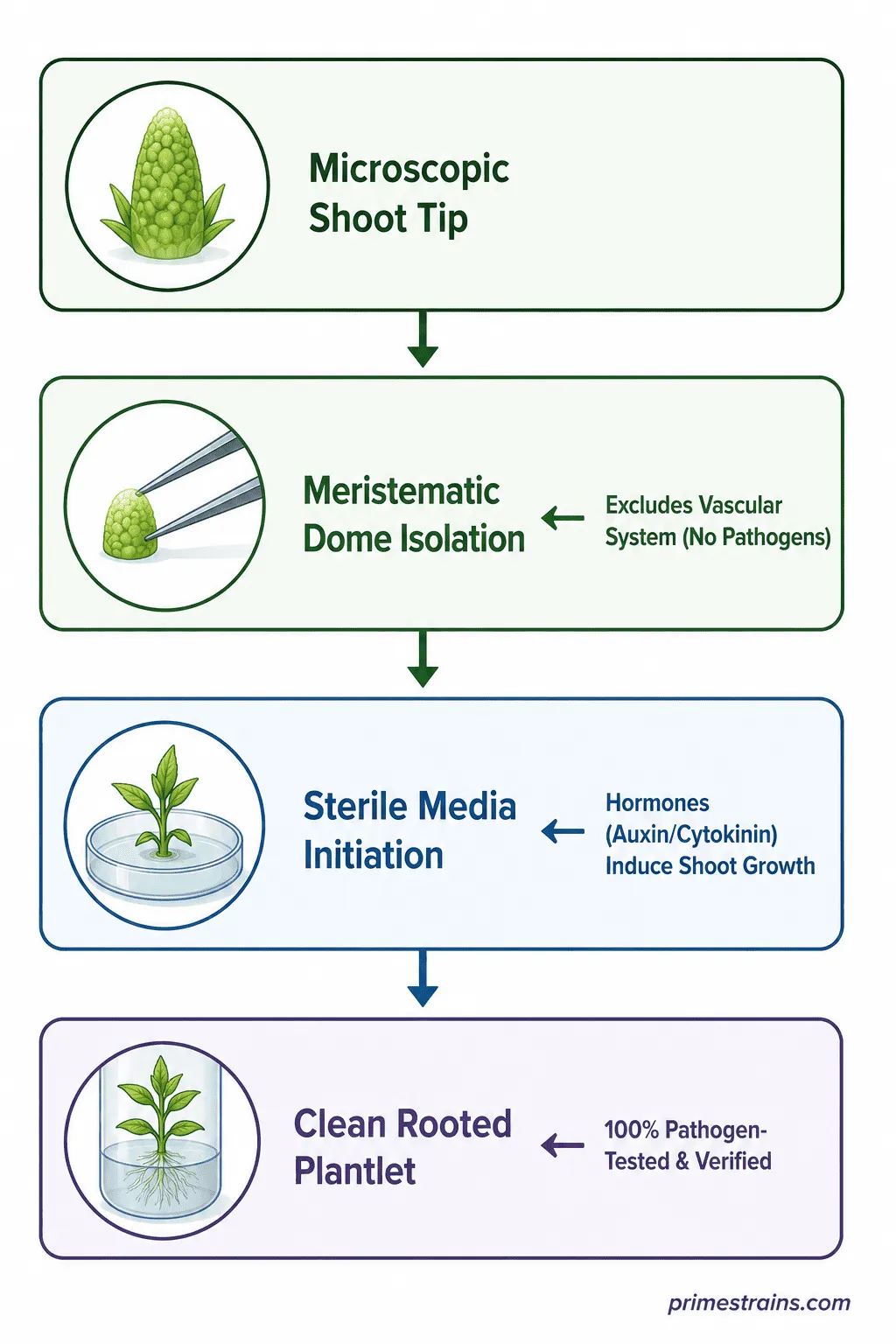
By carefully dissecting and culturing just the 0.2 mm to 0.5 mm meristem dome under a microscope, lab technicians separate clean plant tissue from infected vascular pathways.
2. The 4 Stages of Commercial Micropropagation
- Stage 0: Selection & Sanitation: Candidate mother plants undergo strict diagnostic testing (qPCR for HLVd and fungal screens). Explants are surface-sterilized using mild bleach/ethanol solutions.
- Stage I: Initiation: Clean node or meristem explants are placed into sterile vessel media containing custom balances of salts, vitamins, sucrose, and growth regulators (auxins and cytokinins).
- Stage II: Multiplication: Rapid shoot proliferation. A single healthy tissue node can yield 4 to 8 new shoots every 21–28 days, enabling exponential scaling in minimal space.
- Stage III/IV: Rooting & Acclimatization: Shoots are transferred to rooting media and gradually acclimatized out of high-humidity vessels into standard nursery plug trays for canopy integration.
Traditional Mother Rooms vs. In Vitro Clean Stock Programs
| Criteria | Traditional Mother Room | In Vitro Clean Stock Program |
|---|---|---|
| Facility Space Required | 15% - 25% of total floor footprint | less than 2% of total floor footprint |
| Pathogen Accumulation Risk | Extreme (Dust, pests, systemic HLVd) | Near Zero (Sterile, sealed vessels) |
| Pesticide / Miticide Needs | High (Continuous pest prevention) | Zero (Pest-free lab environment) |
| Labor Overhead | High (Daily watering, pruning, IP testing) | Low (Subculture cycles every 30 days) |
| Genetic Drift & Vigor Loss | High (Aging mothers lose rooting vigor) | Zero (Vigor continuously reset) |
Building a Biosecure Cultivation Pipeline
- Post Pheno-Hunt Safeguarding: Once elite cuts are isolated via data-driven pheno-hunting, immediately initiate them into tissue culture to lock in their genetics.
- Pathogen Screening Audits: Combine micropropagation with mandatory qPCR testing protocols before introducing external clones into your facility.
Frequently asked questions
Can tissue culture fix genetic mutations or bad traits?
No. Tissue culture cleans pathogens (viruses, viroids, bacteria, fungi), but it does not change the plant's underlying DNA sequence. If a cultivar inherently has weak structural traits, micropropagation will preserve those exact traits.
How often should production mother plants be replaced from tissue culture stock?
Commercial best practices recommend cycling out working production mothers every 90 to 120 days. Fresh mothers pulled from in vitro stock maintain peak rooting speed and zero viroid build-up.
Is setting up an internal tissue culture lab expensive for commercial growers?
While initiating an in-house clean room lab requires capital expenditure (laminar flow hoods, autoclaves, and trained lab technicians), many facilities save money by outsourcing initiation/banking to specialized micropropagation nurseries while holding ready-to-root clean stock locally.
Authoritative sources
References supporting factual claims and further reading in this guide.