Pheno-Hunting at Scale: Data-Driven Selection Protocols for Commercial Cultivators
Master commercial cannabis pheno-hunting with data-driven selection protocols. Learn how to systematically score vigor, yield, lab COAs, and extract quality to isolate elite winning cultivars.
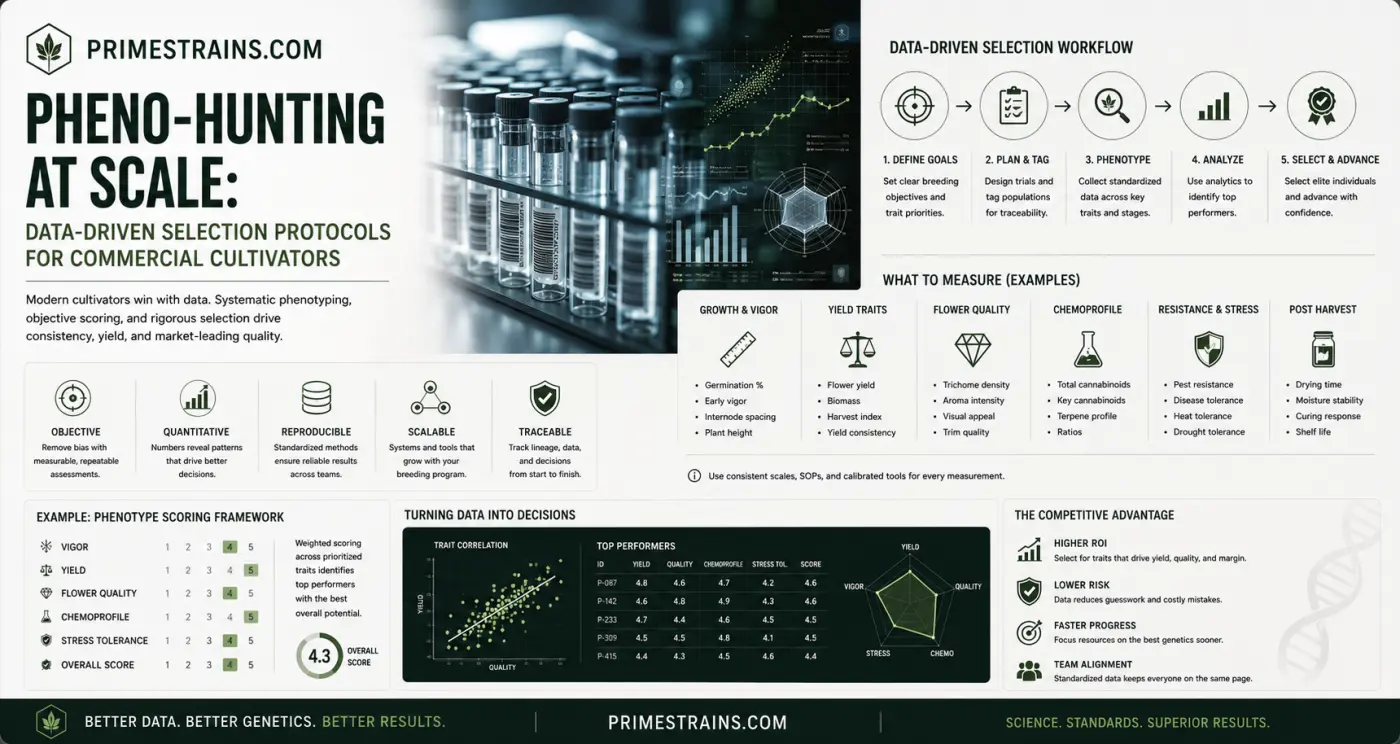
Key takeaways
- Statistical Yield Distribution In standard polyhybrid seed populations, fewer than 5% of individual plants exhibit the complete suite of commercial traits necessary for large-scale production.
- Quantitative Scoring Matrices Commercial selection protocols rely on objective point systems across five core pillars: vigor, structural canopy fit, disease resistance, post-harvest yield, and chemical profile (COA).
- The "Insurance Cut" Rule Taking backup cuttings or placing tissues in cold storage during week two of vegetation ensures that elite genetics are secured before flowering evaluation begins.
- Fresh Frozen Wash Efficiency Extract-focused selection protocols evaluate resin head size, trichome neck brittleness, and total solventless wash percentage (fresh frozen yield) alongside dry flower metrics.
- Environmental Uniformity Valid pheno-hunting requires identical fertigation, lighting, and DLI across the entire test population to isolate true genetic variance from environmental noise.
In a saturated marketplace, relying on lucky discoveries or selecting plants based on visual appeal alone is a costly mistake for commercial operators. Out of a population of 100 seeds—even from elite breeding stock—only 1% to 5% of plants possess the rare combination of high yield, pest resistance, resin density, and chemical potency required to anchor a commercial facility.
To build a defensible genetic portfolio, canopy directors must transition from "eyeball" selection to data-driven pheno-hunting protocols.
Systematic phenotypic evaluation converts subjective observations into verifiable metrics, ensuring that only true commercial performers enter mother rooms or micropropagation vaults.
1. The 5 Pillars of Commercial Strain Selection
When running a selection hunt at scale, candidate plants must pass through five rigorous evaluation checkpoints: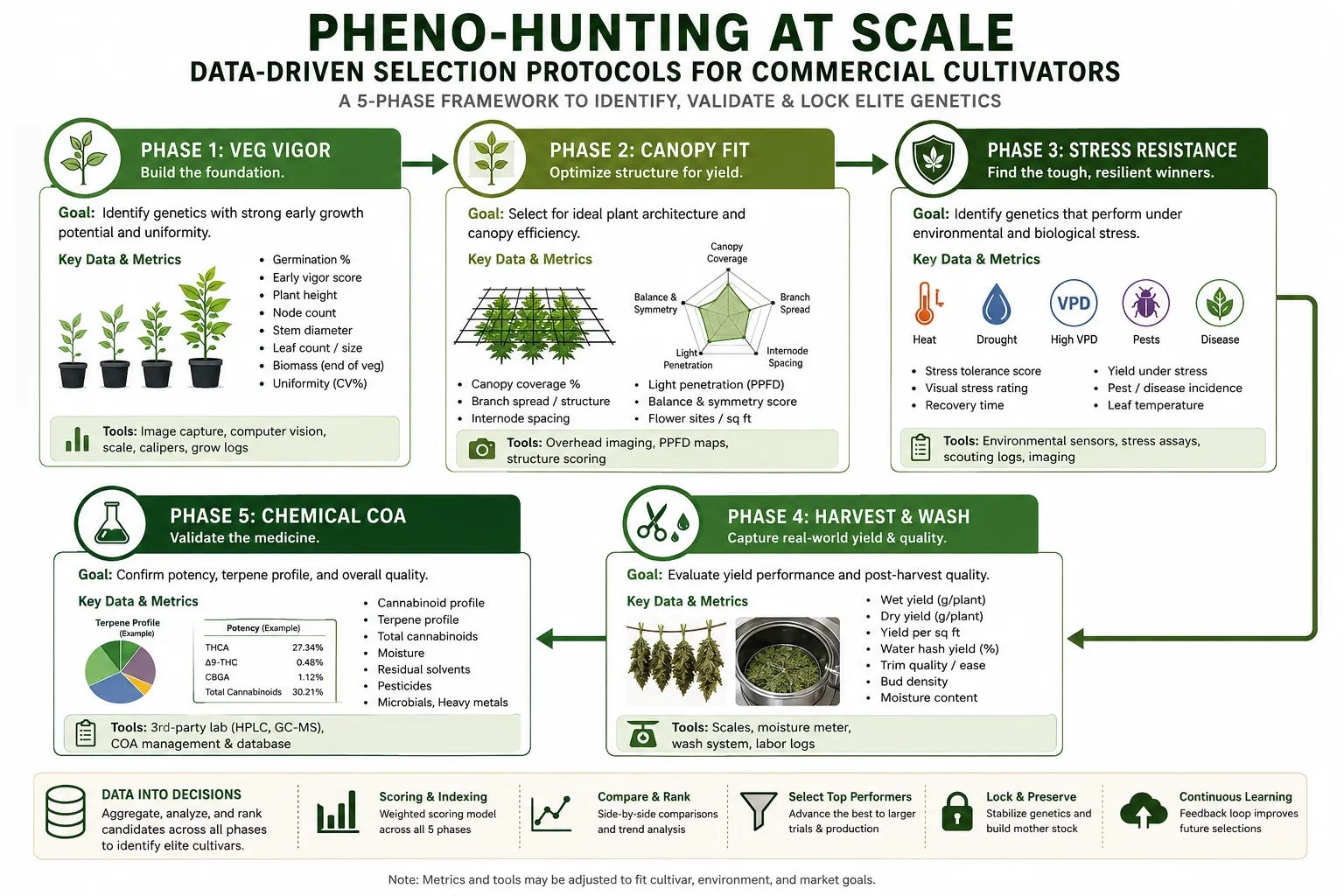
- Vegetative Vigor & Root Speed: Rapid germination, early taproot development, and quick cloning turnarounds save time and energy in nursery stages.
- Structural & Canopy Efficiency: Short internodal spacing, strong lateral stems that reduce staking labor, and high light-penetration efficiency for multi-tier racks.
- Pest & Pathogen Resistance: High biological tolerance against powdery mildew, Botrytis, and spider mites under elevated humidity or temperature stress.
- Post-Harvest Biomass & Extract Yield: High dry flower yield per square foot, favorable calyx-to-leaf ratio for rapid trimming, and superior solventless wash output (4% fresh frozen yield).
- Analytical Potency & Terpene Profile: Total cannabinoid output exceeding 28%, rich terpene complexity (3%), and clean combustion/vape characteristics.
2. Step-by-Step Pheno-Hunting Workflow
Step 1: Population Sizing & Identification
- Batch Sizing: Germinate 100 to 500 seeds per target cultivar to ensure a large enough sample size to catch rare genetic combinations.
- UID Tagging: Apply unique QR code or RFID tags to every seedling container immediately upon germination. Never mix batch tags or rely on manual writing.
Step 2: The Nursery "Insurance Cut"
- Vegetative Cloning: During week two or three of vegetative growth, take 2–3 clone cuttings from every individual candidate plant.
- Parallel Nursery Management: Root and preserve these cuttings under low-intensity light while the main population moves into the flowering room. Discarding backups before flower testing forces facilities to attempt difficult re-veging procedures on winning plants.
Step 3: Mid-Flower & Pre-Harvest Audits
- Scoring Checkpoint 1 (Day 21 Flower): Evaluate stretch ratio, bud site density, and initial trichome coverage. Immediately cull any plant exhibiting hermaphroditic traits.
- Scoring Checkpoint 2 (Day 45–60 Flower): Assess aroma density, resin stickiness, disease susceptibility, and canopy uniformity.
Step 4: Post-Harvest & Analytical Verification
- Weight & Trim Audit: Record wet biomass, dry usable flower weight, and trim ratio for every individual plant ID.
- Laboratory COA: Send test samples from top candidates to an accredited third-party lab for potency, terpene profiling, and heavy metal/microbial screens.
- Mother Selection: Cross-reference physical scorecards with lab analytics. Identify the single top-performing plant ID, promote its corresponding nursery backup cut to mother status, and cull the remaining candidate clones.
Qualitative "Eyeball" vs Quantitative Data-Driven Selection
| Criteria | Intuitive "Eyeball" Selection | Data-Driven Selection Protocol |
|---|---|---|
| Primary Focus | Flower appearance and aroma preference | Yield per sq. ft., COA data, and ROI |
| Record Keeping | Unstructured grower notes | Digital scoring matrices & RFID tracking |
| Pathogen Risk | High (Visual appeal may hide disease) | Low (Integrates stress and pathogen testing) |
| Commercial Scalability | Poor (Hard to repeat across teams) | High (Standardized operating procedure) |
| Error / Failure Rate | 40% - 60% loss of mother candidates | 5% less long-term rejection rate |
Maximizing Selection Efficiency
To lower the capital expenditure of running large selection hunts, combine systematic data tracking with modern seed technology.Frequently asked questions
How many seeds do I need to germinate for a successful commercial pheno hunt?
For standard polyhybrid seeds, a population of 100 to 200 seeds per strain provides a high probability of finding an elite individual. When hunting stabilized True F1 Hybrids, populations can be reduced to 20 to 50 seeds due to genetic uniformity.
When is the best time to cull weak candidates during a pheno hunt?
Initial culling should occur late in the vegetative phase (eliminating slow growers or mutant root structures) and at Day 21 of flower (culling hermaphrodites or low-yielding canopy structures).
Can I run a pheno hunt using feminised seeds?
Yes. Feminised photoperiod seeds are ideal for commercial pheno hunts because every plant produces flower, eliminating the waste of feeding and housing male plants.
Authoritative sources
References supporting factual claims and further reading in this guide.