Feminised vs. Regular vs. Autoflower Seeds: Choosing the Right Format for Commercial Scale
Compare feminised, regular and autoflower seed terminology, flowering behaviour and sourcing considerations, including what format labels cannot guarantee.
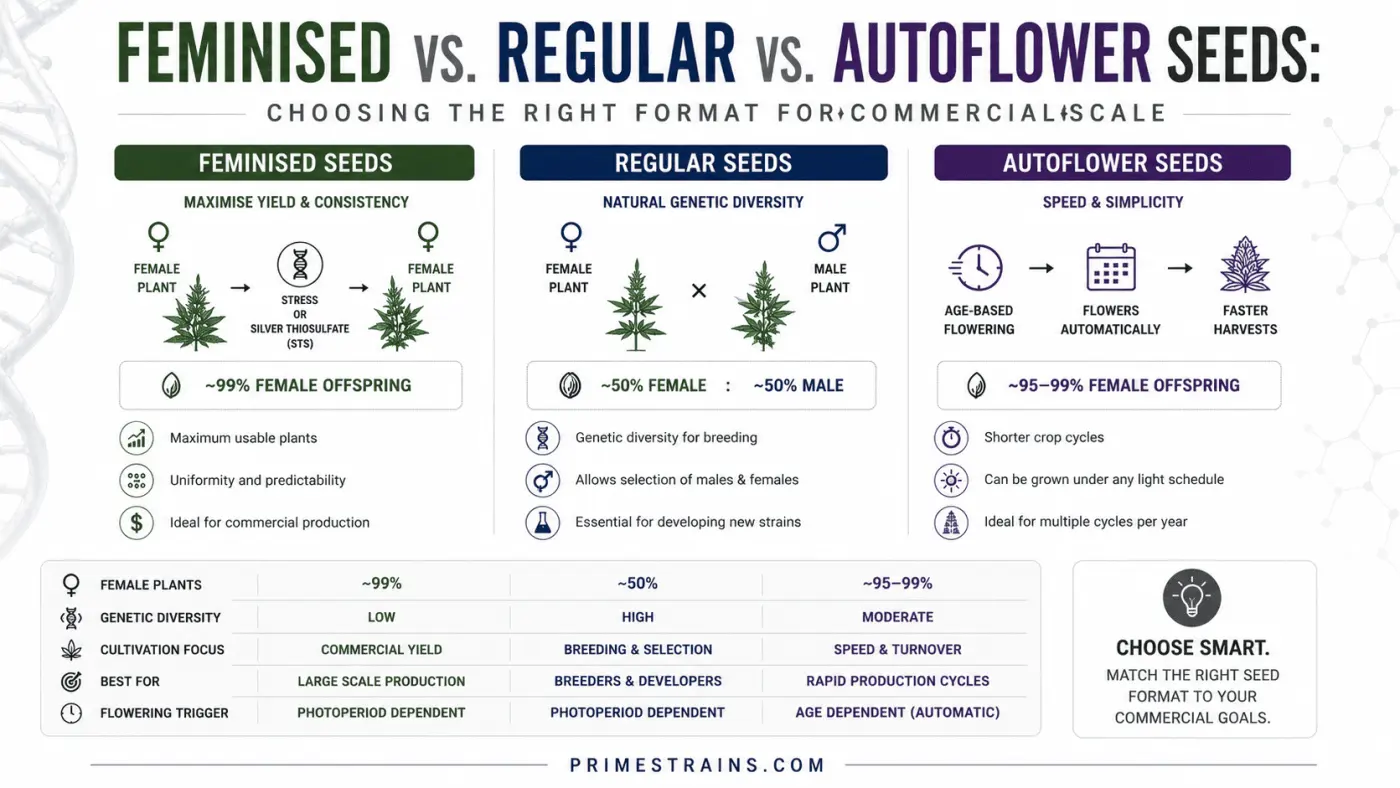
Key takeaways
- Feminised seed mechanics Feminised seed production uses pollen from genetically female plants. The label alone does not establish a universal 99.9% rate or eliminate the need to monitor sex expression.
- Regular Seed Ratios Regular seeds inherit standard X and Y chromosomes, resulting in a naturally occurring 50/50 male-to-female ratio across seed populations.
- Autoflower Photoperiod Independence Autoflower describes flowering behaviour, not a verified ruderalis pedigree or an F1 generation. Check cultivar-specific breeder information for ancestry claims.
- Culling labour Regular-seed crops may require identifying and managing male plants. The labour and space implications depend on the seed lot, workflow and facility; no universal percentage is established here.
- Perpetual Outdoor Harvesting Autoflowers allow outdoor and greenhouse cultivators to run multiple, perpetual seasonal harvests without waiting for autumn light cycle changes.
Choosing the correct seed format is one of the most critical operational decisions for any cultivation facility or serious home grower. Selecting the wrong format can lead to wasted labor, unexpected culling costs, or compromised light cycles.
Feminised and regular describe seed sex formats, while autoflower describes flowering behaviour. F1 is a separate breeding-generation label. Compare the exact cultivar, documented parentage and supplier evidence rather than treating these terms as interchangeable or as guarantees of performance.
Here is a breakdown of how these three primary seed formats function, their underlying mechanics, and how to choose the right option for your facility scale.
1. Feminised Photoperiod Seeds
Feminised seeds are created by inducing a genetically female (XX) plant to produce pollen using ethylene-inhibiting compounds such as Silver Thiosulfate (STS) or colloidal silver.
Feminised seed production is intended to produce female offspring. A universal 99.9% result is not established by the format label alone; evaluate breeder or seed-lot evidence and continue monitoring plant sex expression.

Commercial Advantages
- Maximized Canopy Efficiency: Zero floor space, media, or nutrients wasted on growing males that must be culled.
- Photoperiod Control: Vegetative duration can be shortened or extended based on facility requirements, canopy height limits, or training methods (SCROG/SOG).
- Mother Stock Viability: Outstanding elite phenotypes selected from feminised seed runs can be maintained as perpetual mother plants.
2. Regular Cannabis Seeds (50/50 Male & Female)
Commercial Advantages & Primary Uses
- Essential for Breeding: Male plants are required for classic breeding projects, line stabilization, and developing new filial generations (F1, F2, IBL).
- Pristine Tissue Culture: Certain tissue culture and micropropagation laboratories prefer regular seed stock that has never undergone chemical sex-reversal treatment.
- Rooted in Heritage Lines: Many stabilized ancestral landrace cannabis strains are preserved exclusively in regular seed format to protect their original genetic architecture.
3. Autoflowering Seeds: Flowering Behaviour
Commercial Advantages
- Speed to Harvest: Total lifespan from germination to harvest ranges between 70 - 90 days.
- Perpetual Outdoor Cycles: Outdoor and sun-grown operators in temperate climates can harvest two to three consecutive crops per season.
- Constant High Light Daily Light Integral (DLI): Flowering under an 18/6 or 20/4 light schedule allows plants to absorb maximum daily light energy throughout their entire lifecycle.
Selecting the Right Format for Your Facility
- Indoor Flower Operations: Choose Feminised Photoperiod Seeds or True F1 Feminised Hybrids to eliminate culling labor, optimize multi-tier rack space, and maintain control over canopy timing.
- Greenhouse & Perpetual Field Grows: Utilize Feminised Autoflowers to maximize seasonal crop counts and take advantage of summer sunlight without investing in light-deprivation blackout curtains.
- Breeding & Genetic R&D Labs: Maintain Regular Seeds to hunt elite male donors with superior pollen viability, pest tolerance, and structural stability.
For the distinction between botanical classification and flowering behaviour, read Cannabis ruderalis explained: taxonomy and autoflower labels. The name alone does not verify the ancestry or specifications of an individual seed pack.
Frequently asked questions
What is the difference between feminised, regular, and autoflower seeds?
Feminised describes a seed sex format, regular seeds can produce male and female plants, and autoflower describes flowering behaviour. These labels describe different characteristics: an autoflower can also be feminised or regular. Check the exact cultivar and breeder information rather than assuming a universal female percentage or lifecycle.
Can feminised cannabis plants turn male or produce seeds?
Feminised seeds carry two X chromosomes and do not turn into true male plants. Under severe environmental stress (such as light leaks, heat spikes, or severe drought), female plants may express hermaphroditic traits and produce male pollen sacs. Choosing stable, stress-tested genetics minimizes this risk.
Are F1 hybrid seeds always more uniform or vigorous?
F1 identifies the first filial generation of a cross; it is not a universal performance guarantee. Research on particular cannabis crosses has found improved uniformity and evidence of hybrid vigour, but outcomes depend on the parental lines and the traits measured. Ask for documented parentage and cultivar-specific trial results rather than assuming clone-like uniformity, greater stress resistance or superiority from the label alone.
What is triploid cannabis, and is it guaranteed seedless?
Triploid cannabis has three chromosome sets. Studies of tested triploid cannabis and cannabinoid-hemp plants found reduced seed production compared with diploids, but some triploid plants still formed seeds after pollen exposure. Triploidy therefore does not guarantee seedlessness, and results from particular genotypes should not be treated as a guarantee for every commercial cultivar.
What should be considered when comparing seeds with clones?
Seeds and clones have different sourcing, scheduling and testing requirements. Neither format is automatically pathogen-free: studies have documented hop latent viroid transmission through cannabis or hemp seeds as well as infection in vegetative material. Evaluate supplier health testing and cultivar-specific performance evidence instead of treating F1 or seed-grown as a disease-free guarantee.
Are autoflowering seeds less potent than photoperiod seeds?
The flowering-format label alone does not establish THC, CBD or total cannabinoid content. Compare cultivar-specific evidence and the relevant test method. It is not a guarantee that every autoflower is an F1 hybrid, reaches a particular potency or finishes on the same schedule.
Authoritative sources
References supporting factual claims and further reading in this guide.
- Cannabis ruderalis Janisch. Kew Plants of the World Online powo.science.kew.org
- A FLOWERING LOCUS T ortholog is associated with photoperiod-insensitive flowering in hemp (Cannabis sativa L.) Dowling et al. (2024) pubmed.ncbi.nlm.nih.gov
- Induction of fertile male flowers in genetically female Cannabis sativa plants by silver nitrate and silver thiosulphate anionic complex Mohan Ram and Sett (1982) pubmed.ncbi.nlm.nih.gov
- Cannabis Triploids Exhibit Reduced Fertility and Similar Growth and Flower Production Compared to Diploids Kurtz, Brand and Lubell-Brand (2024) doi.org
- Characterization of agronomic performance and sterility in triploid and diploid cannabinoid hemp Suchoff et al. (2024) doi.org
- F1 Hybrid Seed Can Enhance Cannabis Crop Uniformity and Yield McDonald and Lubell-Brand (2024) doi.org
- New Insights into Hop Latent Viroid Detection, Infectivity, Host Range, and Transmission Primary study (2024) pmc.ncbi.nlm.nih.gov
Feminised Photoperiod vs Autoflower Seeds
| Criteria | Feminised Photoperiod | Feminised Autoflower |
|---|---|---|
| Flowering Trigger | Light cycle shift (12 hrs light / 12 hrs dark) | Biological age (21–35 days after sprout) |
| Seed-to-Harvest Time | 10–16 weeks (Flexible veg time) | 10–12 weeks total (Fixed speed) |
| Female Plant Ratio | Female-oriented seed format; verify breeder or seed-lot information. | Female-oriented only when sold as feminised; verify breeder or seed-lot information. |
| Canopy & Veg Control | Full control (Train, top, or veg as long as needed) | Minimal control (Cannot extend veg phase) |
| Cloning & Mother Stock | Excellent (Can maintain perpetual mother plants) | Poor (Clones bloom automatically on mother's timeline) |
| Best Facility Application | Indoor commercial grows & multi-tier rack setups | Perpetual greenhouse harvests & high-latitude outdoors |