Cannabis Ruderalis Explained: Taxonomy and Autoflower Labels
Understand Cannabis ruderalis, its debated classification and its relationship to autoflower terminology, with botanical and genetic research sources.
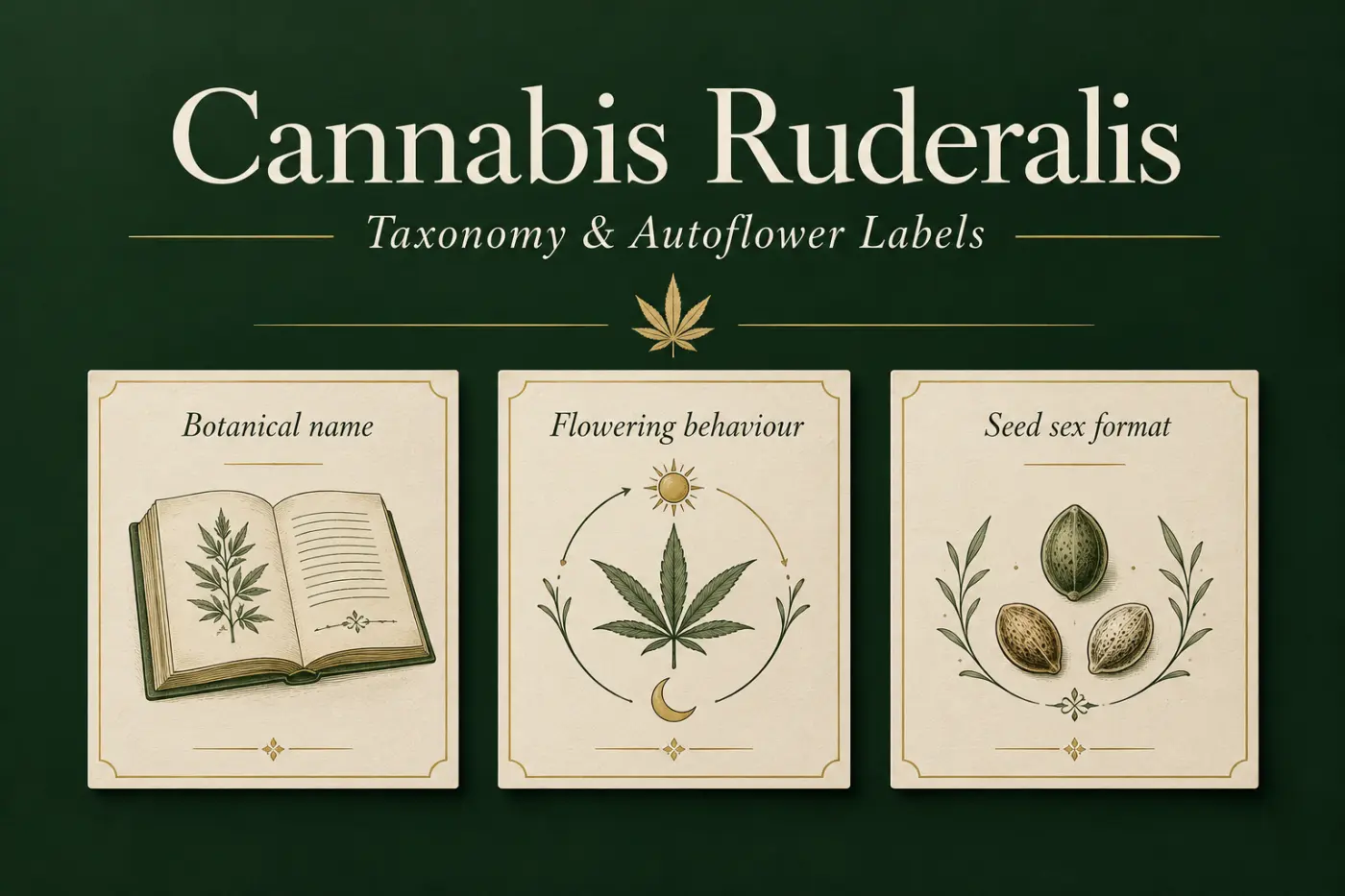
Key takeaways
- Classification State which botanical authority is being followed when discussing ruderalis.
- Flowering behaviour Autoflower and ruderalis are related terms, but they are not interchangeable.
- Seed sex An autoflower is not automatically feminised; check both formats on the exact pack.
- Product evidence Use cultivar-specific breeder information rather than transferring claims from a similarly named product.
Cannabis ruderalis is a historical botanical name often used in discussions of autoflower cannabis. The name and the flowering trait are related ideas, but they are not interchangeable. A taxonomy label describes how a plant is classified; “autoflower” describes flowering behavior.
What does Cannabis ruderalis mean?
The name Cannabis ruderalis Janisch. was first published in 1924. It remains common in seed descriptions and introductory genetics articles. Readers may encounter it presented as a species, a subspecies or a broad description of certain cannabis populations. Those uses do not all express the same scientific position.
Is ruderalis a separate species?
Kew’s Plants of the World Online currently treats Cannabis ruderalis as a synonym of Cannabis sativa. Its record also lists an alternative taxonomic treatment that accepted the name. That is why a simple “third species” explanation can be misleading: the classification depends on the authority being followed.
For a clear explanation, distinguish the historical name from the current classification. A catalogue using the word ruderalis is not, by that word alone, documenting a separate species or a tested pedigree.
Ruderalis and autoflower are different kinds of labels
“Autoflower” refers to relatively photoperiod-insensitive flowering. It does not identify one exact botanical population. “Feminised” addresses a different characteristic again: the seed’s intended sex expression. A pack can therefore be described as both autoflowering and feminised without either word replacing the other.
Compare the descriptions in the autoflower seed category and the feminised seed category. Read the exact breeder and cultivar alongside the format. A category label is a useful starting point, rather than a complete account of a pack’s genetics.
What genetic research has established
Toth and colleagues’ 2022 study identified major flowering-time loci called Autoflower1 and Early1. The authors discussed uncertainty around attributing autoflowering universally to a distinct ruderalis group.
Dowling and colleagues’ 2024 hemp study identified another associated locus, Autoflower2, and reported evidence for multiple independent origins of photoperiod insensitivity in Cannabis sativa. These findings support a more careful explanation than “every autoflower comes from one pure ruderalis ancestor.” They do not establish the pedigree of every commercial seed pack.
Reading a seed label without overinterpreting it
Keep four questions separate: who produced the pack, which named cultivar it contains, what flowering format is described, and what sex format is described. If a description adds an ancestry claim, look for a breeder statement or another source specific to that cultivar.
The word ruderalis does not give you a laboratory cannabinoid result, an individual effect or a verified product specification. Avoid transferring figures from a similarly named variety to a different breeder’s pack. Our seed-format comparison covers the broader terminology; this explainer focuses on the botanical name and its limits.
Sources
- Cannabis ruderalis Janisch. — Kew, Plants of the World Online.
- Identification and mapping of major-effect flowering time loci Autoflower1 and Early1 in Cannabis sativa L. — Toth et al., Frontiers in Plant Science, 2022.
- A FLOWERING LOCUS T ortholog is associated with photoperiod-insensitive flowering in hemp (Cannabis sativa L.) — Dowling et al., The Plant Journal, 2024.
Frequently asked questions
Is every autoflower pure ruderalis?
No. Autoflower describes a trait, and it does not certify a pure botanical lineage. The ancestry of a particular pack requires evidence specific to that pack.
Does ruderalis specify THC or CBD content?
No. The name alone is not a cannabinoid measurement. Treat any stated figure as a separate product claim that needs a relevant source.
Is an autoflower always feminised?
No. Flowering format and sex format describe different characteristics. Check both on the exact pack.
Authoritative sources
References supporting factual claims and further reading in this guide.
- Cannabis ruderalis Janisch. Kew Plants of the World Online powo.science.kew.org
- Identification and mapping of major-effect flowering time loci Autoflower1 and Early1 in Cannabis sativa L. Toth et al., Frontiers in Plant Science (2022) frontiersin.org
- A FLOWERING LOCUS T ortholog is associated with photoperiod-insensitive flowering in hemp (Cannabis sativa L.) Dowling et al., The Plant Journal (2024) pubmed.ncbi.nlm.nih.gov