Cannabis Pistils: What They Are and What Their Colour Can Tell You
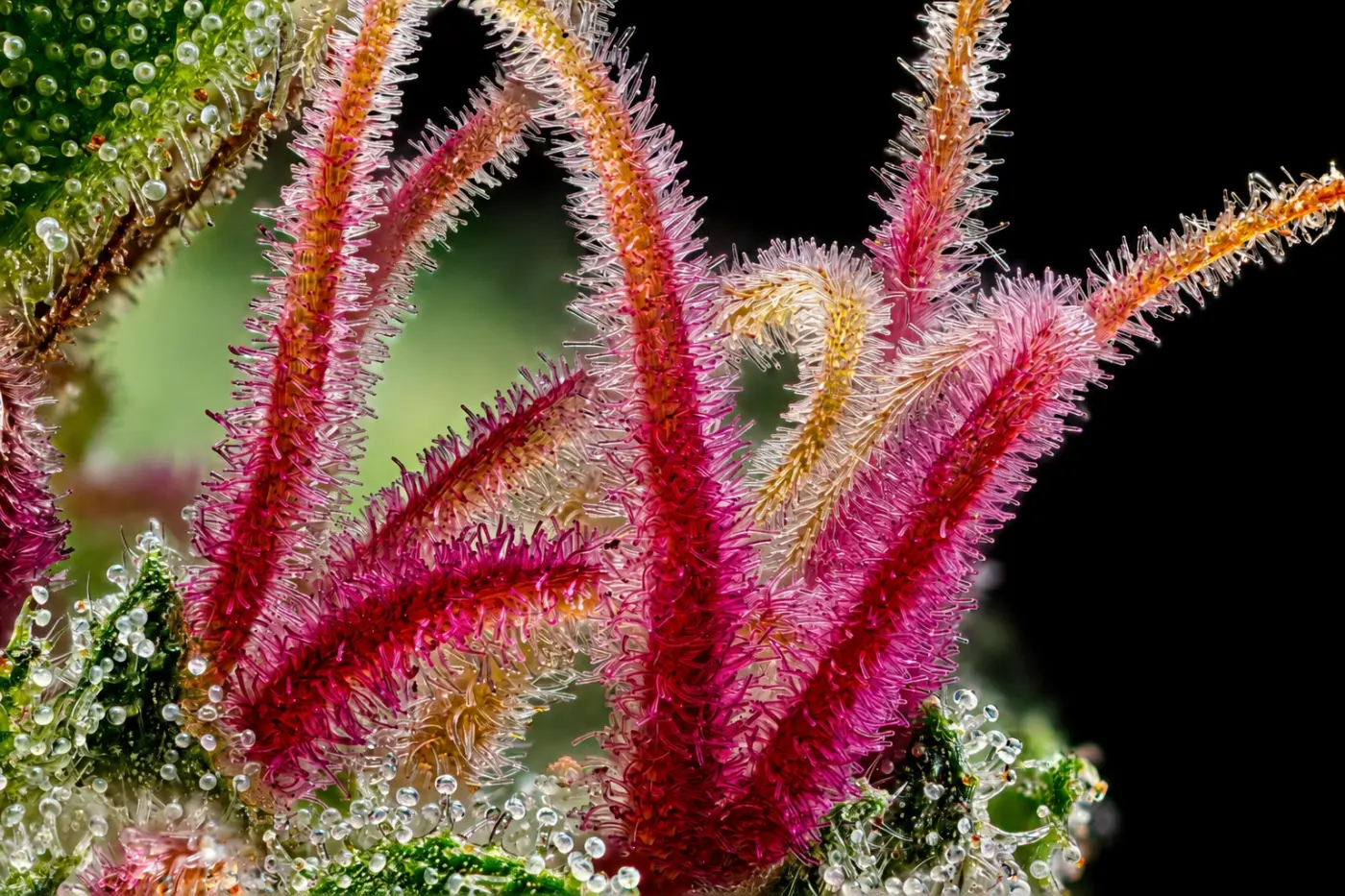
The hair-like structures on cannabis buds are technically stigmas—the pollen-receptive tip of the female pistil. While their color shift from pale white to orange or brown signals floral aging, stigma color alone cannot prove cannabinoid potency, harvest readiness, or seed formation.
Key takeaways
- Botanical Identity The hair-like structures protruding from female cannabis flowers are technically stigmas, which form the pollen-capturing tip of the female pistil.
- Color Change Causes Stigmas transition from white to orange, rust, or brown due to natural tissue aging, genetic anthocyanin expression, pollination, or environmental desiccation.
- Potency Misconceptions Stigma tissue contains minimal resin glands; its coloration does not correlate with THC levels, CBD percentage, or terpene richness.
- Magnification Required Stigmas indicate when a plant is nearing the end of its lifecycle, but glandular trichome head opacity (cloudy vs. amber) is the only reliable guide for peak harvest timing.
The thin, hair-like structures protruding from female cannabis flowers are commonly referred to as pistils. Botanically, however, the visible strands are stigmas—the pollen-capturing extensions of the female plant's reproductive system. During early flowering, stigmas emerge as rigid, pale white or cream-colored strands. As the flower develops, oxidizes, or reacts to environmental conditions, these strands wither, curl inward, and transition to shades of yellow, orange, red, rust, or deep brown.
While stigma color reflects general flower maturation and environmental exposure, color alone does not prove cannabinoid potency, exact harvest readiness, or seed development.
Cannabis Botanical Anatomy: Pistils vs. Stigmas
In popular grower terminology, every hair on a cannabis bud is called a "pistil." In botanical terms, the pistil represents the complete female organ, which consists of three distinct parts:
- Anatomy Breakdown: Ovary: Enclosed inside the ovule-bearing calyx (bract) at the base of the structure.
- Anatomy Breakdown: Style: The tissue neck connecting the ovary to the receptive surface.
- Anatomy Breakdown: Stigma: The dual, hair-like extensions that protrude into the open air to trap airborne pollen.
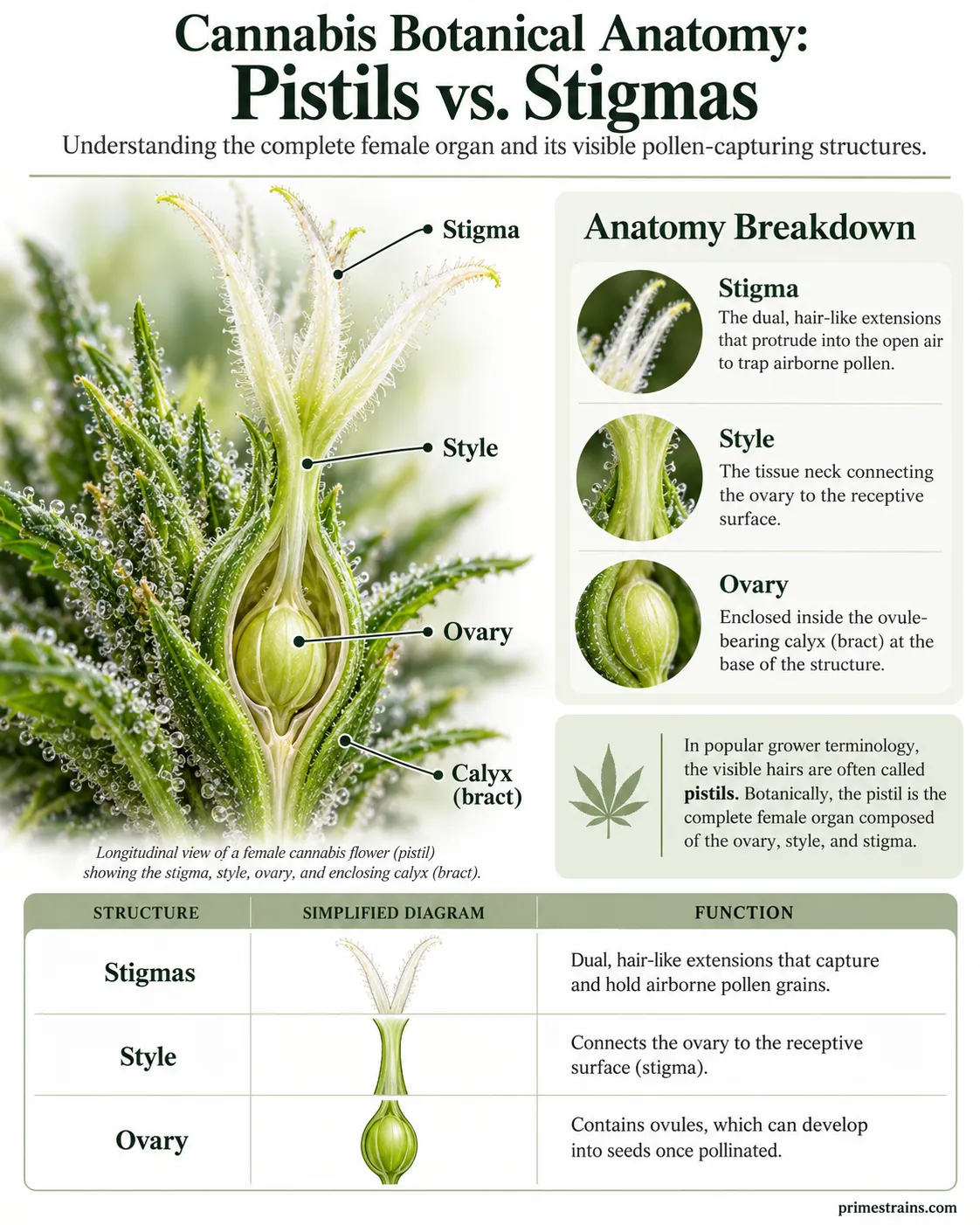
What growers observe with the naked eye are the stigmas. These structures are covered in microscopic glandular papillae designed to catch airborne pollen grains. When pollen lands on a receptive stigma, it germinates and grows a tube down through the style to fertilize the ovule, initiating seed production.
In unpollinated (sinsemilla) cultivation, female plants continue producing new calyxes and stigmas in an attempt to capture pollen, causing flowers to swell and stack over time.
Distinguishing Stigmas from Other Flower Structures
Female cannabis inflorescences consist of several distinct anatomical parts. Confusing these structures often leads to misdiagnoses during cultivation.
| Structure | Visual Appearance | Primary Function | Key Difference |
|---|---|---|---|
| Stigma ("Pistil") | Thin, strand-like hairs; white, orange, red, or brown | Captures airborne pollen for fertilization | Non-glandular hair; changes color rapidly with age/stress |
| Trichome (Capitate) | Microscopic stalked glands; clear, milky/cloudy, or amber | Synthesizes cannabinoids, terpenes, and secondary metabolites | Resin-producing organ; turns clear to milky to amber |
| Stipule | Tiny, green, needle-like leaf outgrowth at stem nodes | Structural support/protection at nodal junctions | Solid green plant tissue; does not capture pollen |
| Pollen Sac (Anther) | Bulbous, bell-shaped cluster (resembles small bananas) | Male reproductive organ; produces and releases pollen | Found on male/hermaphrodite plants, not female calyxes |
Understanding these distinctions prevents common errors, such as confusing resin-rich glandular trichomes with pollen-capturing stigmas. For details on how plant architecture varies across lineages, see our guide on Indica vs. Sativa Plant Characteristics.
Why Cannabis Stigmas Change Colour
Stigma color transitions are driven by natural biological aging (senescence), genetic expression, and external stressors.
1. Natural Senescence and Maturation
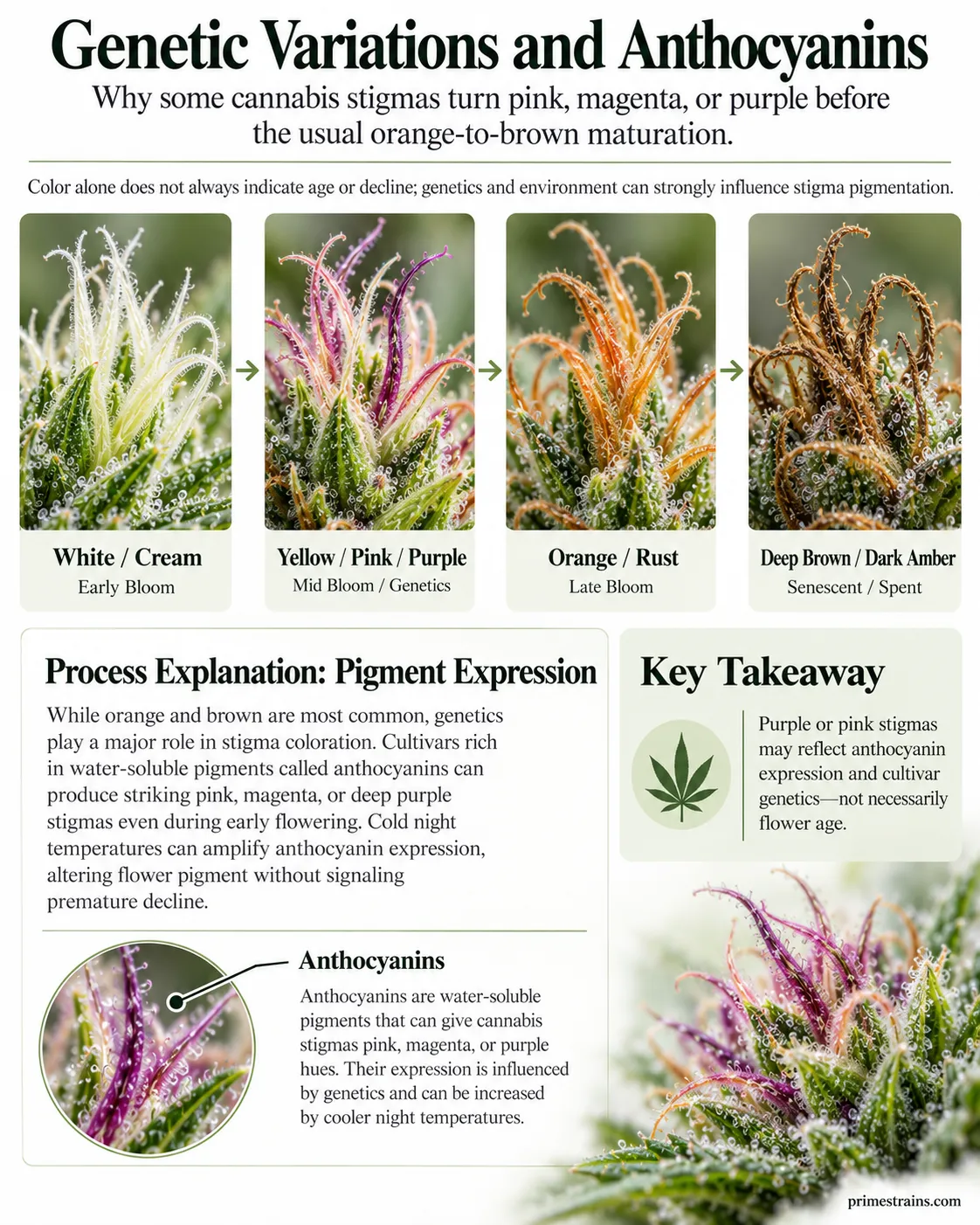
- Process Explanation: Tissue Breakdown: Early in the bloom phase, stigmas are filled with moisture and cell sap, giving them a rigid, bright white appearance. As individual calyxes age and pass their peak receptivity window, the cells within the stigma undergo oxidation, causing the tissue to lose turgor pressure, collapse, curl inward, and darken into yellow, orange, rust, or brown tones.
2. Genetic Variations and Anthocyanins
- Process Explanation: Pigment Expression: While orange and brown are most common, genetics play a major role in coloration. Cultivars rich in water-soluble pigments called anthocyanins can produce striking pink, magenta, or deep purple stigmas even during early flowering. Cold night temperatures can amplify anthocyanin expression, altering flower pigment without signaling premature decline.
3. Pollination Responses
- Process Explanation: Post-Fertilization Shutdown: When an open stigma receives viable pollen, its biological role is fulfilled. The plant rapidly redirects energy away from maintaining that stigma and toward seed development inside the ovary. Consequently, pollinated stigmas wither, dry out, and turn brown or black far more rapidly than unpollinated ones.
4. Environmental Stress and Mechanical Damage
- Factor: Physical Touch: Manual handling or brush contact breaks fragile surface cells, turning tips brown prematurely.
- Factor: Airflow/Wind Shear: Direct, high-velocity air movement from circulation fans desiccates stigma tips.
- Factor: Foliar Sprays: Applying water, organic oils, or soaps late in bloom burns stigma tissues on contact.
- Factor: Heat & Low Humidity: Extreme vapor pressure deficits (VPD) dry out stigmas rapidly before surrounding tissue matures.
Coexistence of White and Dark Stigmas
It is entirely normal to see fresh white stigmas emerging alongside older, withered orange or brown stigmas on the same flower mass.
Cannabis inflorescences do not develop as a single uniform structure; rather, they grow through continuous calyx stacking. As light reaches lower nodes or as the plant experiences late-flowering growth spurts (often called "foxtailing"), new calyxes swell and throw out fresh, receptive white stigmas. Simultaneously, older stigmas at the interior or base of the bud complete their lifecycle and darken.
To see where flower maturation fits into the complete life cycle, explore the Cannabis Growing Stages Timeline.
The Limitations of Stigma Colour: What It Can and Cannot Prove
Relying solely on stigma coloration leads to incorrect assumptions about plant health and harvest timing.
| What Stigma Observation CAN Suggest | What Stigma Observation CANNOT Prove On Its Own |
|---|---|
| • General phase of flower aging | • Precise harvest readiness |
| • Exposure to environmental stress | • Cannabinoid percentage (THC/CBD) |
| • Possible exposure to pollen | • Successful seed formation |
| • Phenotypic pigment expression | • Terpene concentration or profile |
| • Physical or spray damage | • Plant sex or genetic purity |
- Does NOT Prove Pollination: While pollinated stigmas turn brown, unpollinated stigmas also turn brown purely from age or environmental drying.
- Does NOT Prove Potency: Stigma tissues contain minimal glandular trichomes; their coloration does not correlate with total THC, CBD, or terpene synthesis.
- Does NOT Guarantee Harvest Readiness: A plant subjected to severe fan burn may display 90% brown stigmas while its resin glands remain clear and immature.
Stigma Colour vs. Trichome Inspection
To make informed cultivation decisions, growers must differentiate between what macro-level stigmas show and what micro-level trichomes reveal.
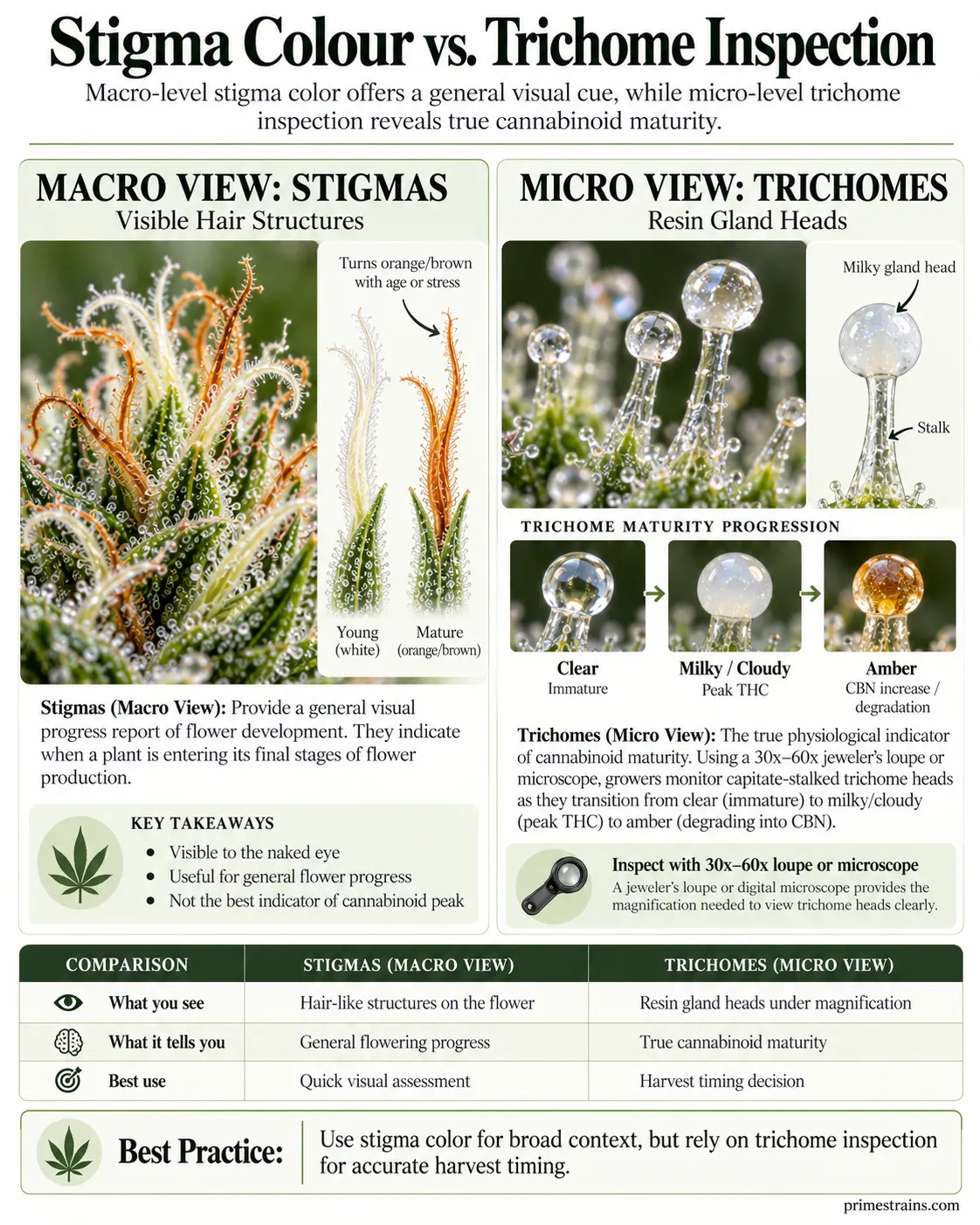
- Stigmas (Macro View): Provide a general visual progress report of flower development. They indicate when a plant is entering its final stages of flower production.
- Trichomes (Micro View): The true physiological indicator of cannabinoid maturity. Using a 30x–60x jeweler's loupe or microscope, growers monitor capitate-stalked trichome heads as they transition from clear (immature) to milky/cloudy (peak THC) to amber (degrading into CBN).
Key Rule: Never harvest based on stigma color alone. Stigmas signal when to start inspecting trichomes under magnification.
Observation & Diagnostic Framework
Use this structured matrix to evaluate flower observations objectively rather than relying on rapid assumptions.
Observation Analysis Table
| Visual Observation | Possible Explanations | What It Does Not Prove | What to Check Next |
|---|---|---|---|
| All stigmas bright white and upright | Early flower stage; high turgor pressure; plant actively seeking pollen. | Does not prove low potential potency; does not prove plant is nitrogen deficient. | Check flowering timeline week count; inspect lower nodes for preflower formation. |
| Stigmas turning brown rapidly on one side only | Direct fan/wind stress; proximity to light/heat; localized physical handling. | Does not prove plant-wide ripening; does not confirm male pollen presence. | Check fan placement and air velocity; review recent training or spray history. |
| Stigmas brown early across whole canopy (Weeks 2–4) | Pollination event; severe pesticide/spray burn; extreme heat stress. | Does not prove seed setting is guaranteed; does not mean crop is ruined. | Inspect calyxes for swelling/seeds; check nearby plants for male flowers or hermies. |
| 80%+ brown stigmas with fresh white bursts | Late-stage flower stacking; high-light intensity spurts; natural late bloom. | Does not prove plant is overripe; does not mean trichomes are amber. | Examine trichomes on mature calyxes (not leaves) using 40x magnification. |
| Pink, red, or purple stigmas | Anthocyanin accumulation; genetics; cooler night temperatures. | Does not prove high fruit flavor; does not indicate nutrient toxicity. | Check strain genetic profile and ambient night temperatures. |
Concise Observation Checklist
When inspecting flowers, follow this methodical workflow before making environmental adjustments or harvesting:
- Location Check: Document Location: Is the color change uniform across the top canopy, or isolated near fans, lights, or walkways?
- History Check: Review Handling History: Have the flowers been touched, pruned, or sprayed with foliar treatments in the past 48 hours?
- Environment Check: Inspect Air Circulation: Is a circulation fan blowing directly onto the affected buds?
- Anatomy Check: Examine Calyx Base: Gently inspect the calyx at the base of darkened stigmas. Is it unusually firm or swollen, suggesting seed growth?
- Maturity Check: Magnify Trichomes: Use a 40x–60x loupe on calyx trichomes (ignore sugar leaves) to determine true maturity.
If you suspect environmental issues like excessive moisture or rot alongside darkening flower tissue, consult our guide on Mold on Weed: How to Spot, Prevent, and Treat Bud Rot. For post-harvest processing once mature, see Outdoor Cannabis Harvest, Drying, and Curing Guide.
Frequently asked questions
What are the hairs on cannabis flowers called?
The visible hairs are called stigmas. While commonly referred to as "pistils" by growers, the stigma is actually one specific part of the pistil responsible for catching airborne pollen.
Do orange hairs mean cannabis is ready to harvest?
Not necessarily. While browning stigmas show that flowers are maturing, factors like wind, handling, or heat can turn them brown early. Always confirm maturity by checking trichome heads with a magnifying tool.
Why are pistils turning brown early in the flowering stage?
Early browning is typically caused by environmental stress—such as fan burn, high heat, low humidity, or foliar sprays—or by accidental pollination from male pollen.
Can white pistils remain on fully mature buds?
Yes. Many cultivars produce new bursts of calyxes and white stigmas late in bloom, especially under intense lighting. If trichomes are cloudy or amber, the plant may be mature despite fresh white hairs.
Does the number of orange hairs affect potency or THC levels?
No. Stigmas do not produce significant cannabinoids. Potency is determined by resin produced in glandular trichomes, not by the density or color of visible hairs.
Authoritative sources
References supporting factual claims and further reading in this guide.
- Architecture and Florogenesis in Female Cannabis sativa Plants Spitzer-Rimon et al. (2019), as supplied pmc.ncbi.nlm.nih.gov
- Cannabis Glandular Trichomes: A Cellular Metabolite Factory Livingston et al. (2021), as supplied frontiersin.org
- Hemp Sex-Ed: A Primer on Pollination Oregon State University Extension (2020), as supplied extension.oregonstate.edu
- Comparative Genomics of Flowering Behavior in Cannabis sativa PMC (2023), as supplied pmc.ncbi.nlm.nih.gov