Facility Automation & Environmental Controls: Vapor Pressure Deficit (VPD), CO2 Dynamics, and HVACD Balancing for Multi-Tier Canopies
Master commercial facility automation and environmental controls. Learn how to manage Vapor Pressure Deficit (VPD), carbon dioxide (CO2) enrichment, and HVACD balancing across multi-tier indoor canopies.
Key takeaways
- The VPD Driving Force Vapor Pressure Deficit (VPD) dictates the evaporative demand placed on leaf stomata, directly regulating transpiration rates, nutrient uptake speed, and leaf surface cooling.
- Target VPD Stages Optimal cannabis performance requires an early vegetative VPD of 0.8–1.1 kPa, shifting to a mid-flower target of 1.2–1.5 kPa, and ending with a late-flower stress target of 1.5–1.8 kPa.
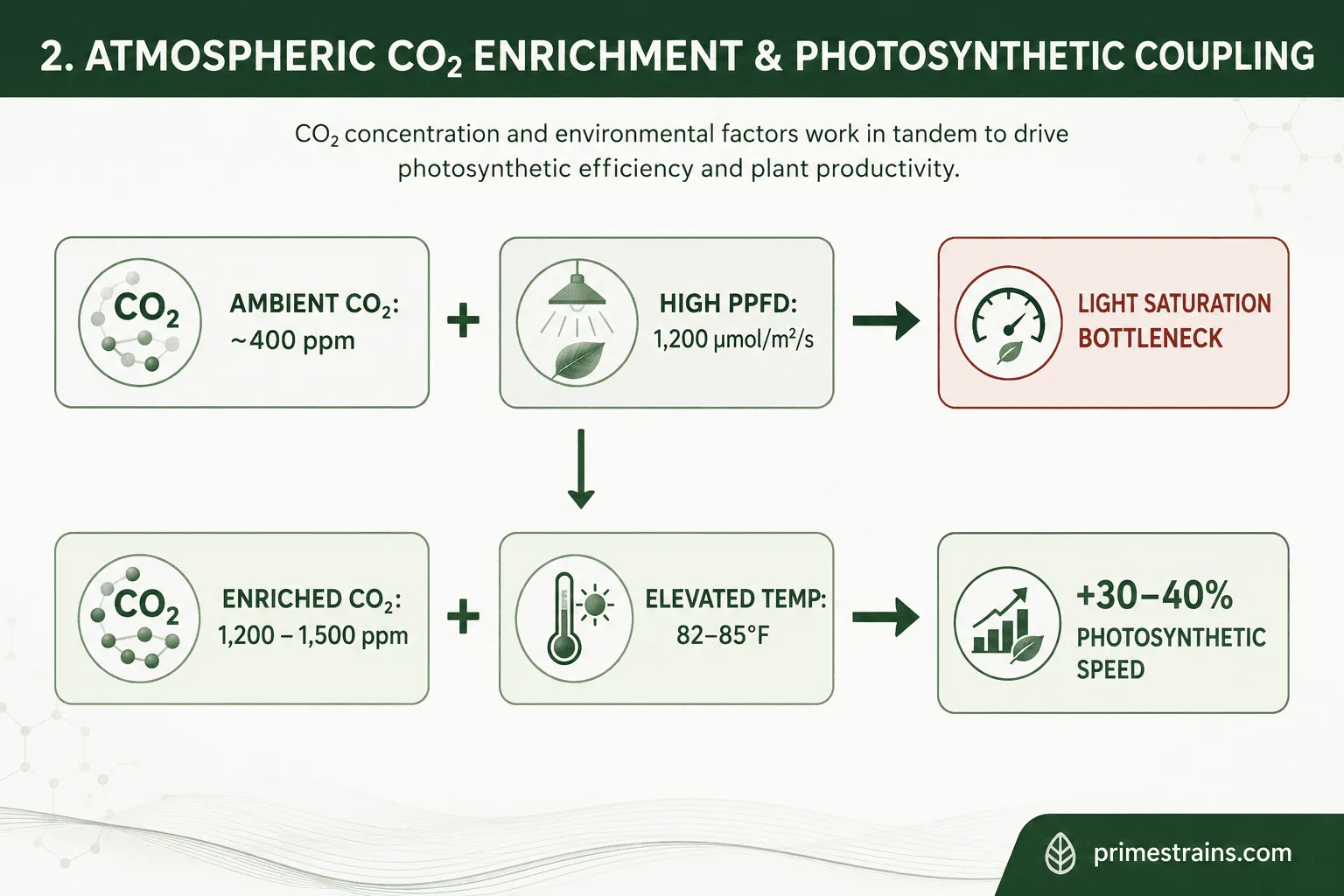
- CO2 Enrichment Thresholds Supplementing atmospheric CO2 to 1,200–1,500 ppm during lights-on increases the light saturation point, allowing plants to convert ultra-high PPFD without photo-inhibition.
- Sensible vs. Latent HVACD Demands High-density LED rooms generate lower sensible (heat) loads but significantly higher latent (transpiration moisture) loads, requiring industrial dehumidification engineered for peak transpiration windows.
- Multi-Tier Microclimate Airflow Vertical multi-tier systems require dedicated canvas ducting or horizontal airflow (HAF) fans to eliminate thermal stratification and boundary-layer humidity buildup between rack levels.
In commercial indoor cannabis facilities, maintaining precise environmental microclimates is the ultimate driver of metabolic speed and yield consistency. While genetics and fertigation provide the baseline potential, real-time control over Vapor Pressure Deficit (VPD), ambient carbon dioxide (CO2) concentration, and HVACD (Heating, Ventilation, Air Conditioning, and Dehumidification) capacity dictates actual photosynthetic conversion rates.
As commercial facilities scale to vertical multi-tier racking, microclimatic stratification creates localized temperature and humidity pockets. Without integrated Building Management Systems (BMS) and automated environmental steering, microclimate variance causes uneven transpiration, nutrient lockouts, and fungal outbreaks.
1. The Physics of Vapor Pressure Deficit (VPD)
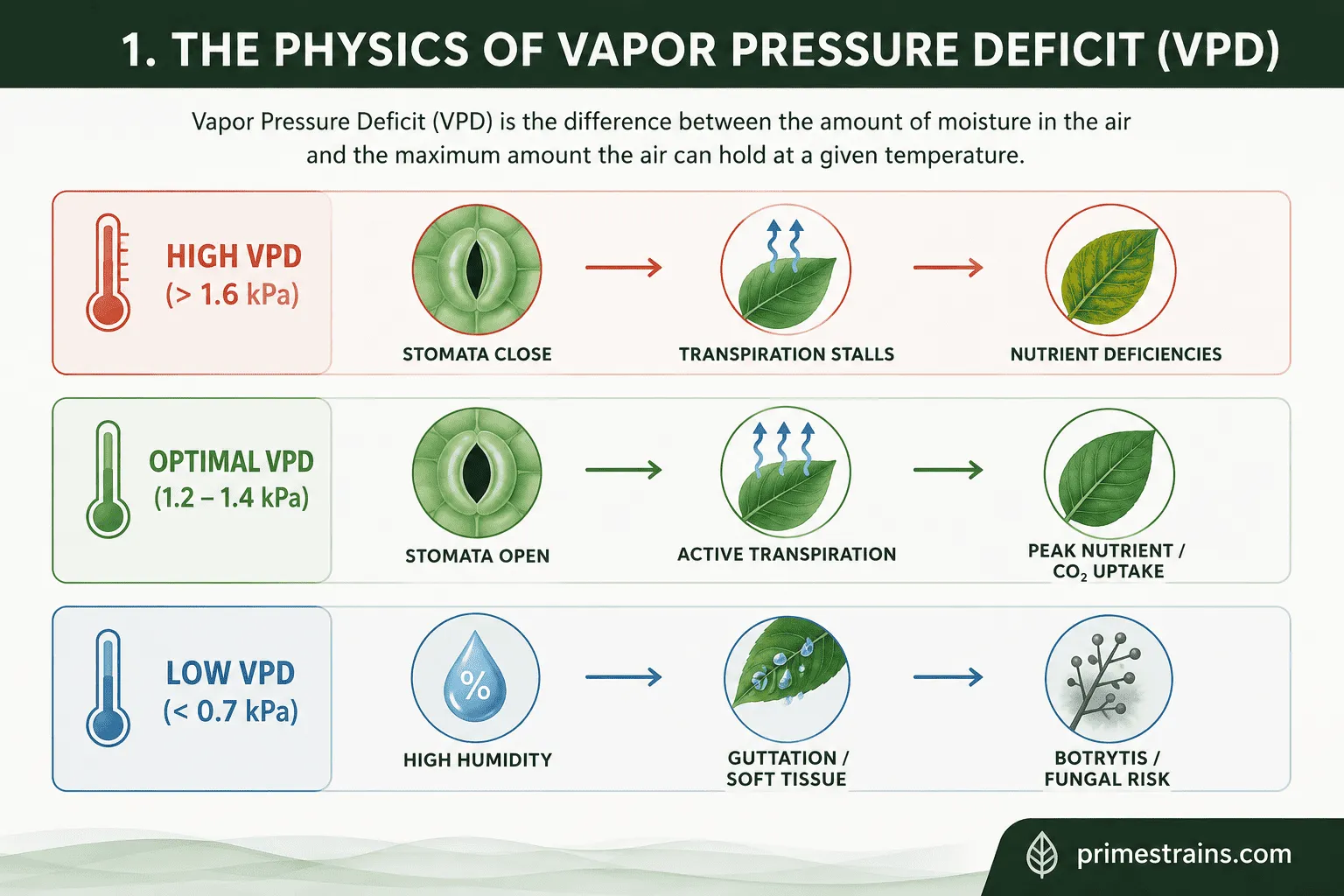
- Low VPD (<0.8 kPa): Air is near saturation. Transpiration slows, preventing the plant from pulling essential calcium and magnesium upward through the xylem. Excess internal pressure can cause guttation and fungal spore germination.
- Optimal VPD (1.1–1.5 kPa): Creates an ideal transpiration pull. Stomata remain fully open, maximizing CO2 intake while maintaining steady water and mineral transport.
- High VPD (>1.6 kPa): Evaporative demand is too aggressive. To prevent desiccation, the plant triggers stomatal closure, suppressing photosynthesis and burning metabolic energy.
2. Atmospheric CO2 Enrichment & Photosynthetic Coupling
- Vegetative Stage: Maintain 800–1,000 ppm CO2 to support rapid cell division and branch architecture expansion.
- Generative Flower Stage: Elevate CO2 to 1,200–1,500 ppm during all lights-on hours.
- Lights-Off Dosing: Shut off CO2 completely during night cycles. Plants do not fix carbon in the dark; elevated nighttime CO2 wastes gas and can induce phytotoxicity.
Environmental Parameters Across Crop Growth Stages
| Criteria | Vegetative Stage | Generative Flower Stage |
|---|---|---|
| Target Air Temperature | 80 - 84°F (26.6 - 28.8°C) | 72 - 85°F (22.2 - 29.4°C) |
| Target Leaf Temp (LST) | 78 - 81°F | 70 - 82°F |
| Relative Humidity (RH) | 60% - 70% | 40% - 65% |
| Target VPD Range | 0.9 - 1.1 kPa | 1.1 - 1.7 kPa |
| Ambient CO2 Concentration | 800 - 1,000 ppm | 1,200 - 1,500 ppm |
3. HVACD Engineering & Multi-Tier Airflow Dynamics
Overcoming Microclimate Stratification in Multi-Tier Racks
- Fluid Micro-Ducting: Install dedicated under-bench micro-ducts or duct socks that blow low-velocity air directly across the lower canopy plane to break boundary layer resistance.
- Integrated BMS Sensors: Place aspirated sensor modules (measuring temp, RH, and CO2) at canopy height on every rack tier rather than relying on a single wall-mounted sensor.
- Dehumidification Ramp Up: Automate pre-cooling and dehumidification 30 minutes prior to lights-off to capture the spike in relative humidity caused by rapidly falling air temperatures.
4. Unifying Automation with Cultivation Operations
- Preventing Pest Habitat: Maintaining strict target VPD curves acts as a primary line of defense in your commercial Integrated Pest Management (IPM) program by eliminating leaf moisture that enables fungal spore germination.
- Transpiration & Fertigation Alignment: Pair automated VPD adjustments with precision fertigation and crop steering strategies to adjust root-zone EC alongside daily transpiration demands.
- Maximizing High-PPFD Photobiology: Integrate automated CO2 dosing directly with LED lighting spectrum and DLI optimization targets to achieve maximum photosynthetic efficiency without light stress.
Frequently asked questions
Why is Leaf Surface Temperature (LST) lower than ambient air temperature under LEDs?
LED fixtures radiate very little infrared (IR) heat compared to legacy HPS bulbs. Because the light source does not heat the physical leaf tissue directly, transpirational cooling causes the leaf to sit 2–5°F colder than the surrounding room air.
What causes microclimates in vertical multi-tier rooms?
Microclimates occur when airflow distribution is insufficient to overcome vertical heat stratification and localized canopy transpiration pockets. Without active horizontal airflow across every tier level, moisture and heat become trapped within dense foliage.
How does elevated CO2 affect plant temperature tolerance?
Elevated CO2 (1,200–1,500 ppm) increases the thermal optimum for photosynthesis. Plants under enriched CO2 operate more efficiently at higher air temperatures (82–85°F), accelerating enzymatic activity in the Calvin cycle without inducing heat stress.
Authoritative sources
References supporting factual claims and further reading in this guide.
- Frontiers in Plant Science (2025) Elevated Relative Humidity Significantly Decreases Cannabinoid Concentrations While Delaying Flowering Development in Cannabis sativa L. pmc.ncbi.nlm.nih.gov
- Physiology and Molecular Biology of Plants (2008) Photosynthetic Response of Cannabis sativa L. to Variations in Photosynthetic Photon Flux Densities, Temperature and CO2 Conditions pmc.ncbi.nlm.nih.gov