Precision Fertigation & Crop Steering: Generative vs. Vegetative Irrigation Strategies for Commercial Canopies
Master commercial cannabis crop steering and precision fertigation. Learn how to manipulate Volumetric Water Content (VWC), Electrical Conductivity (EC), and drybacks to trigger vegetative versus generative plant responses.
Key takeaways
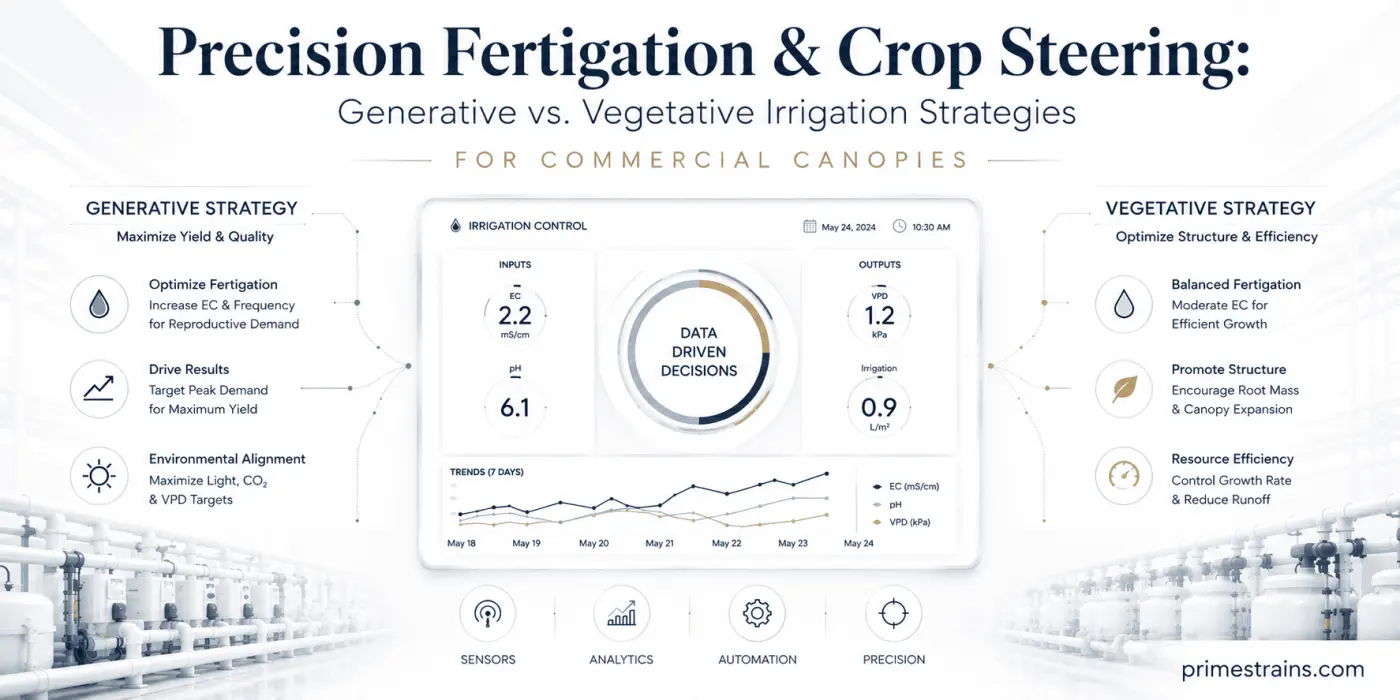
- The Core Steering Levers Crop steering manipulates substrate water content (VWC %), root-zone electrical conductivity (EC), and irrigation shot sizes to trigger specific hormonal responses in the plant.
- Vegetative Irrigation Cues High substrate VWC, low EC, small overnight dryback percentages (10% - 15%), and frequent small irrigation shots signal the plant to build stems, fan leaves, and robust root systems.
- Generative Irrigation Cues Lower substrate VWC, elevated EC levels, larger overnight drybacks (20% - 30%), and larger, less frequent irrigation shots signal the plant to halt vertical stretch and invest energy into flower mass, terpene, and cannabinoid synthesis.
- Overnight Dryback Management Monitoring the percentage drop in substrate moisture from the final irrigation shot of the day to the first shot of the next morning prevents root hypoxia while setting the daily steering direction.
- Substrate Sensor Integration Precision crop steering relies on substrate TDR/FDR sensors inserted directly into rockwool or coco media to measure VWC, EC, and root-zone temperature in real time.
In high-density commercial cannabis cultivation, traditional schedule-based watering is being replaced by data-driven crop steering. Rather than simply supplying water and nutrients for basic hydration, precision fertigation leverages substrate sensor data to send specific physiological signals to the crop.
By systematically manipulating Volumetric Water Content (VWC), Electrical Conductivity (EC) in the root zone, and overnight drybacks, canopy directors can dictate plant architecture—steering crops toward aggressive vegetative expansion or pushing them into dense, resin-heavy generative flower development.
1. The Physiology of Substrate Crop Steering
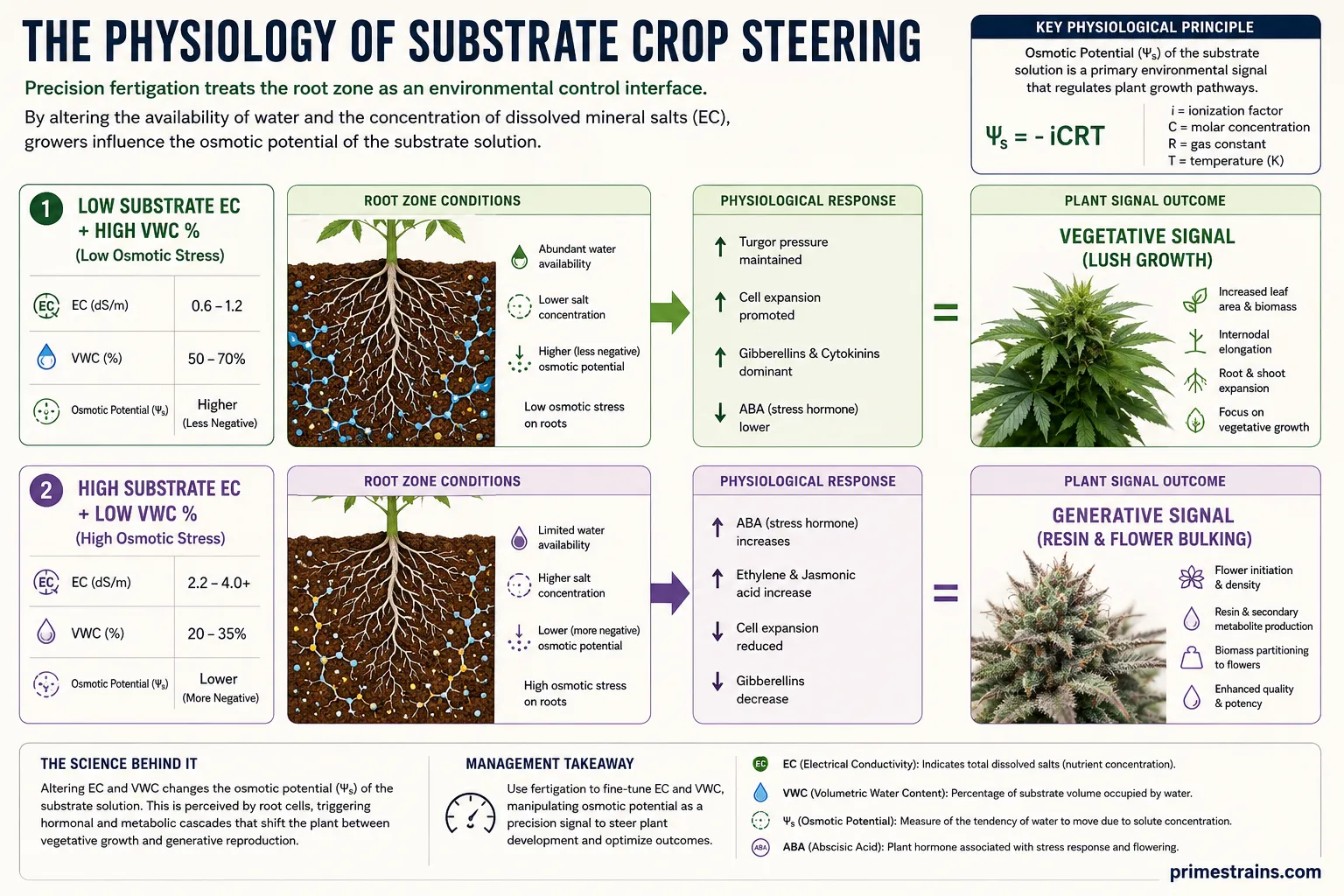
- Vegetative Steering (Low Stress): When water is abundant and root-zone EC is moderate (2.5 - 3.5mS/cm), roots absorb water effortlessly via osmotic pressure. Turgor pressure remains high, driving rapid cell expansion, stem elongation, and leaf development.
- Generative Steering (Controlled Osmotic Stress): Raising root-zone EC (5.0 - 8.0 + mS/cm) or allowing substrate VWC to drop creates mild osmotic resistance. The root system must expend more energy to draw in water. The plant interprets this controlled stress as an environmental signal to prioritize reproductive survival, resulting in denser flower stacking, increased calyx-to-leaf ratios, and elevated secondary metabolite (THC and terpene) synthesis.
2. Irrigation Shot Scheduling: P1, P2, and P3 Phases
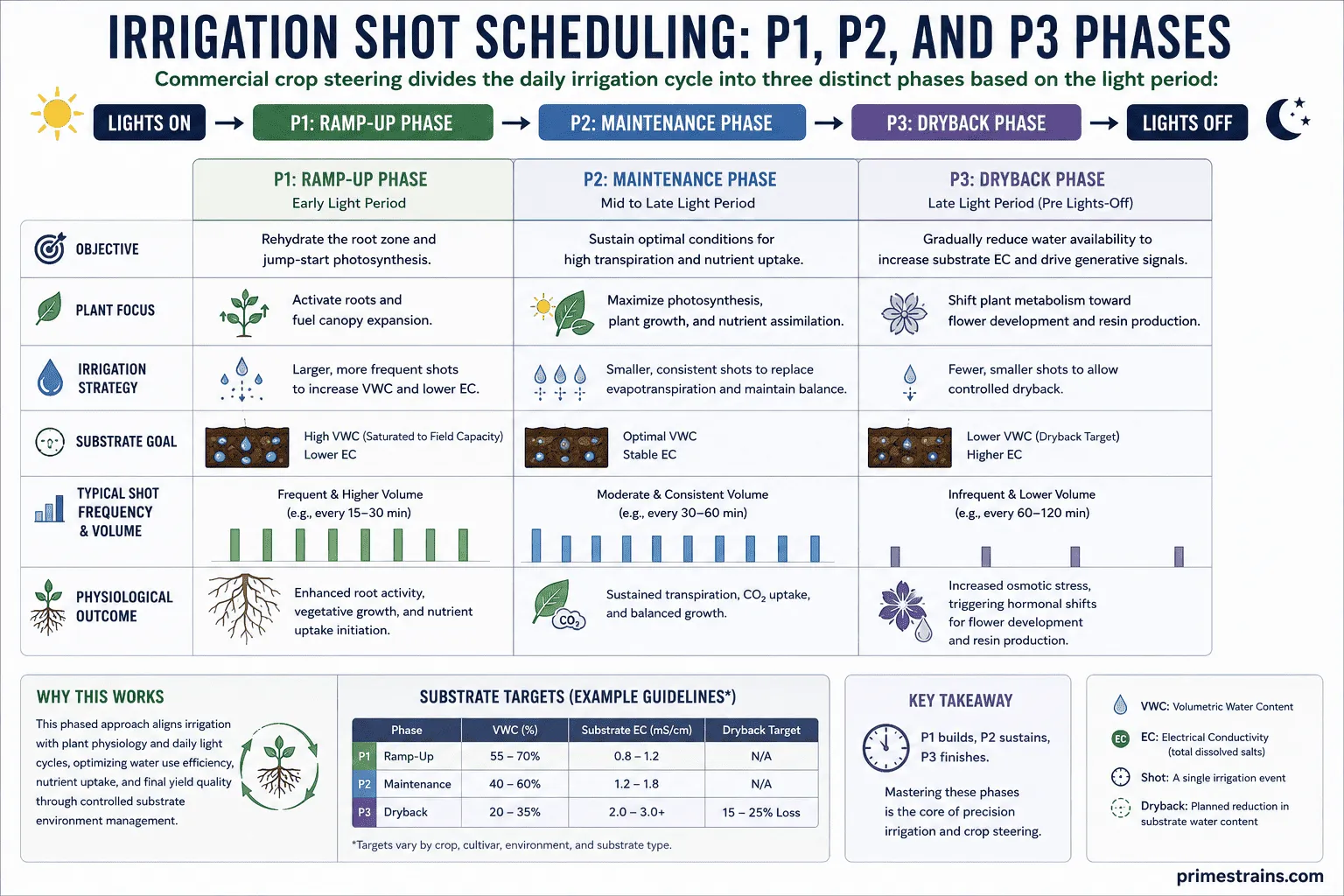
Vegetative vs. Generative Fertigation Strategy
| Criteria | Vegetative Steering Mode | Generative Steering Mode |
|---|---|---|
| Fertigation Parameter | Canopy growth, stem thickness, leaf area | Flower stacking, resin density, bulking |
| Target Substrate VWC | High (60% - 70%) | Moderate to Low (45% - 55%) |
| Root-Zone EC Level | Lower (2.5 - 3.5 mS/cm) | Elevated (5.0 - 8.0+ mS/cm) |
| Overnight Dryback Target | Small (10% - 15%) | Deep (20% - 30%) |
| Irrigation Shot Size | Small (1% - 3% of media volume) | Large (4% - 8% of media volume) |
| Shot Frequency | Frequent shots throughout day | Fewer, larger shots with longer pauses |
3. Integrating Crop Steering with Facility Infrastructure
- High-PPFD Alignment: Match generative irrigation drybacks with high light delivery by optimizing your LED spectrum and DLI lighting targets to maximize photosynthetic carbon fixation under elevated CO2.
- Canopy Trait Uniformity: Deploying uniform True F1 hybrid seeds ensures every plant across the bay has identical root mass and transpiration rates, preventing dryback variance across substrate slabs.
- Structural Training: Combine vegetative steering phases with SCROG and canopy trellising protocols during early transition to fill trellis screens before shifting into generative bulking modes.
Frequently asked questions
What happens if the overnight dryback is too large?
If an overnight dryback exceeds 35% - 40% depending on the substrate volume, the root zone can dry out excessively, causing severe water stress, root tip dieback, and salt accumulation. This leads to nutrient lockout, blossom end necrosis, and permanent yield loss.
Should I steer vegetatively or generatively during late flower ripening?
During the final 10 to 14 days before harvest (the ripening/flush phase), many commercial growers shift back toward a mild vegetative or balanced irrigation strategy with reduced EC. This softens root-zone salt stress, encourages complete nutrient uptake, and allows the plant to consume internal carbohydrate reserves for a smoother finished smoke profile.
Can crop steering be implemented in living soil or organic media?
While crop steering principles apply to all substrates, precision VWC and EC steering using sharp drybacks is most effective in inert substrates like rockwool or coconut coir. Organic living soil relies on soil microbiology and higher moisture retention, where extreme drybacks can damage beneficial microbial populations.
Authoritative sources
References supporting factual claims and further reading in this guide.