LED Lighting & DLI Optimization: Spectrum Tuning, Photoperiod Strategy, and Energy Management for High-PPFD Canopies
Optimize commercial LED lighting strategies and Daily Light Integral (DLI) targets. Learn how spectrum tuning, high-PPFD deployment, and HVAC energy balancing drive canopy photosynthesis and yield.
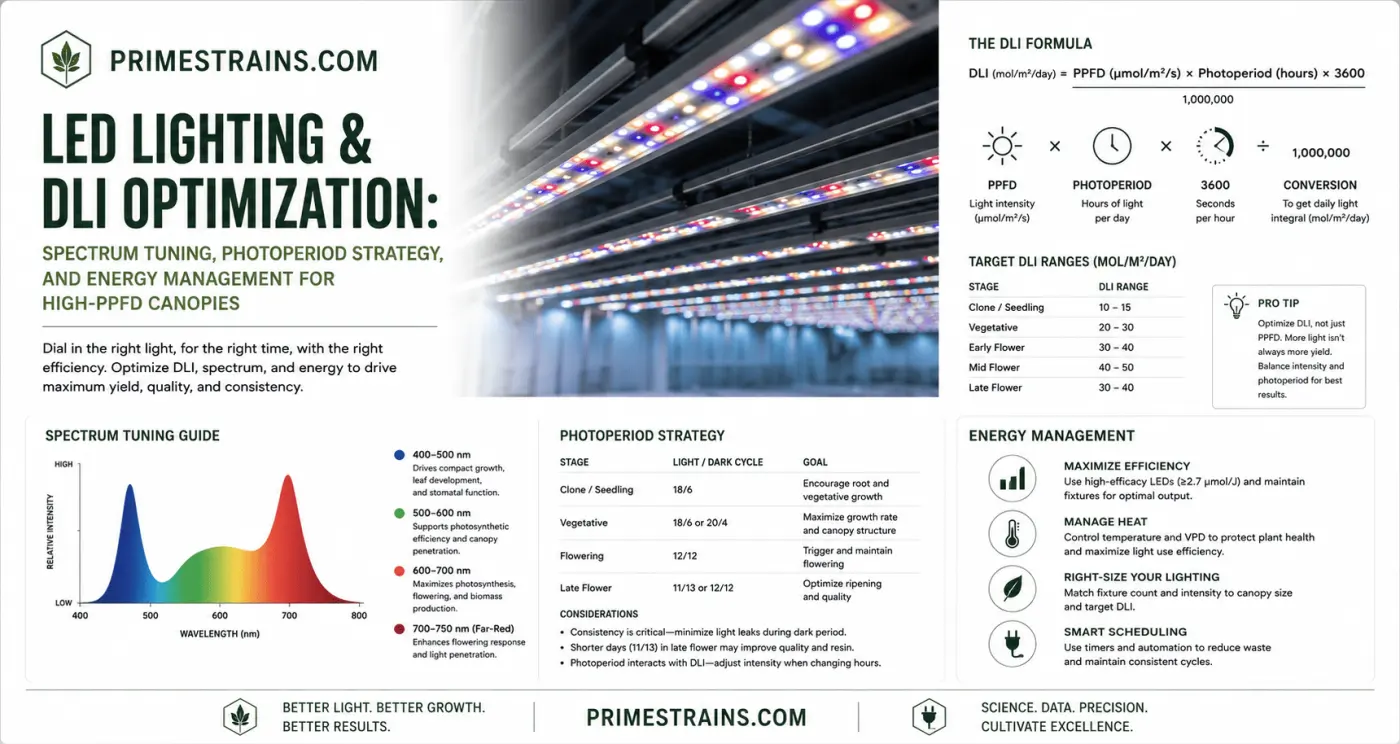
Key takeaways
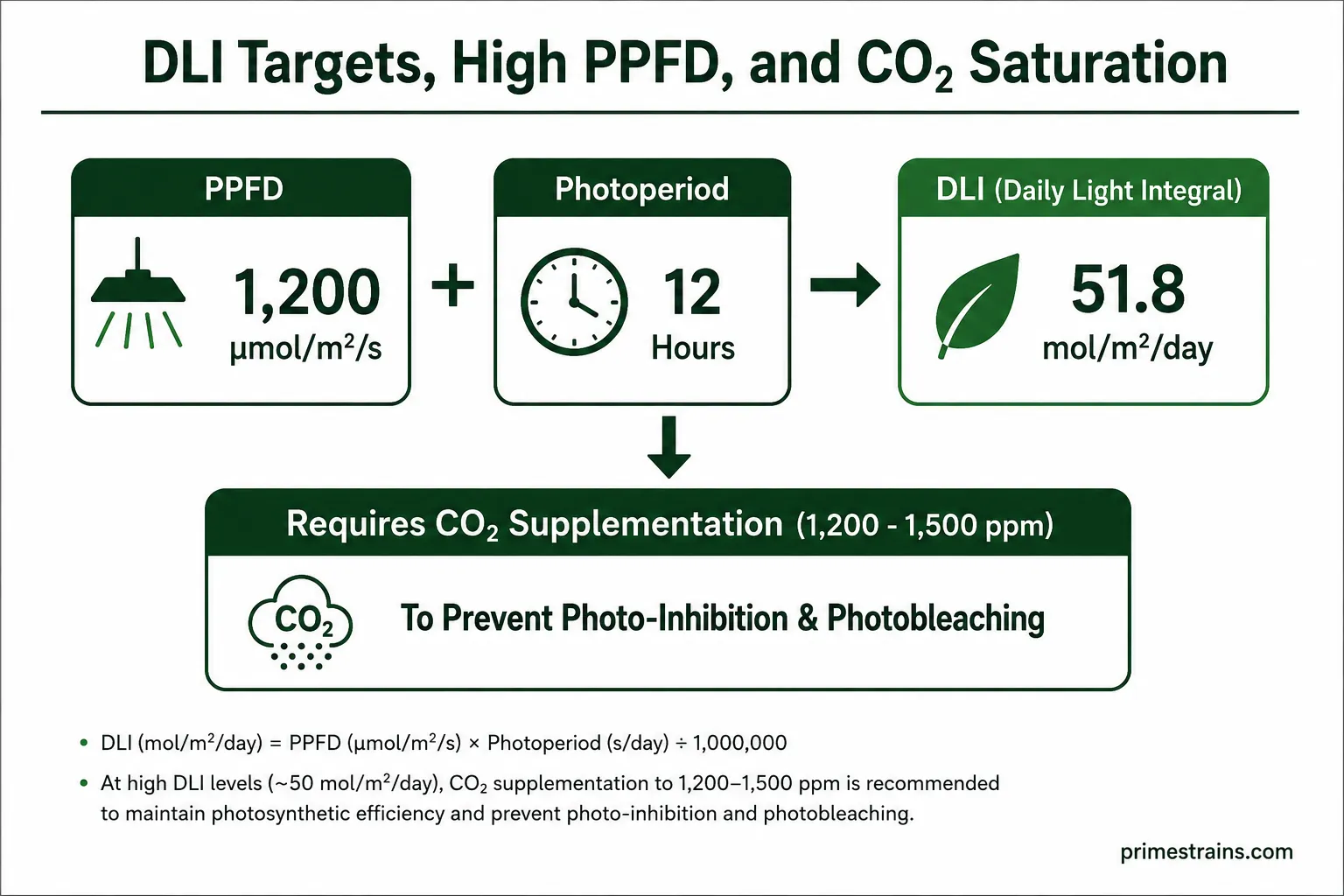
- Target DLI Thresholds Achieving optimal floral yields requires delivering a DLI of 45–60 mol/m2 /day during the flowering stage, supported by elevated atmospheric carbon dioxide (CO2).
- CO2 Coupling Requirement Pushing photosynthetic photon flux density (PPFD) past 1,000 umol/m2 /s without supplementing CO2 to 1,200–1,500 ppm induces photo-inhibition and limits light utilization efficiency.
- Morphological Control via Far-Red Incorporating far-red wavelengths (730 nm) during transition triggers shade avoidance responses to accelerate branch extension, while far-red end-of-day (EOD) pulses shorten flowering cycle perception.
- UV Boosting for Metabolites Targeted ultraviolet (UVA/UVB) stress application during late flowering stimulates glandular trichome density and increases total cannabinoid/terpene accumulation.
- Sensible vs. Latent HVAC Shifts LED fixtures convert less energy into direct radiant heat (infrared) than HPS, requiring commercial facilities to adjust HVAC dehumidification capacity to handle higher plant transpiration rates.
The transition from High-Pressure Sodium (HPS) to light-emitting diode (LED) technology has fundamentally reshaped commercial cannabis cultivation economics. However, simply replacing fixture for fixture without adjusting environmental parameters often leads to underperforming canopies, light stress, or unmanageable microclimates.
To maximize operational efficiency, canopy directors must move past simple wattage calculations and master Daily Light Integral (DLI) targets, precision spectrum tuning, and high-PPFD integration (>1,000–1,500 umol/m2 /s).
1. DLI Targets, High PPFD, and CO2 Saturation
2. Spectrum Tuning: Manipulating Plant Photomorphogenesis
- Blue Light (400–500 nm): Dominates vegetative spectrums. Promotes stomatal opening, suppresses internodal stretching, and produces thick, broad leaves with high chlorophyll density.
- Deep Red (660 nm): Aligns with peak chlorophyll a and b absorption spectra. Drives biomass production, flower expansion, and photosynthetic speed during the main bloom phase.
- Far-Red (730 nm): Drives the Emerson Enhancement Effect when delivered alongside red light, increasing overall photosynthetic efficiency. Far-red exposure during transition encourages rapid stretch to fill trellis netting.
- Ultraviolet (UVA 315–400 nm / UVB 280–315 nm): Acts as an abiotic stressor. Low-dose UV exposure during the final 2–3 weeks of flower triggers defense mechanisms, increasing trichome density and secondary terpene expression.
Legacy High-Pressure Sodium (HPS) vs. Tunable Spectrum LED
| Criteria | Legacy High-Pressure Sodium (HPS) | Modern Tunable Spectrum LED |
|---|---|---|
| Fixture Efficiency (Efficacy) | Low (∼ 1.7 umol/J) | High (2.7–3.2+ umol/J) |
| Spectral Control | Fixed yellow/orange dominant | Dynamic (Customizable veg, flower, & UV) |
| Radiant Thermal Output (IR) | Extreme (Heats leaf surface directly) | Low (Conductive heat directed upward to sinks) |
| Canopy Penetration | Single-point source light degradation | Distributed multi-bar illumination |
| Electrical Energy Savings | Baseline | 30%–45% HVAC & Lighting Reduction |
3. HVAC Integration & Canopy Thermal Dynamics
- Air Temperature Adjustments: Ambient air setpoints in LED flower rooms must be raised to 80–84°F (26.6–28.8°C) during lights-on to keep LST in the optimal photosynthetic range (78–82°F).
- Dehumidification Loads: Because higher room temperatures drive faster plant transpiration, HVAC equipment must handle an increased latent heat (moisture) load, requiring dedicated commercial dehumidification capacity.
4. Aligning Lighting Strategies with Facility Genetics
- Structural Training Under High Intensity: Combine high-PPFD deployment with SCROG and multi-tier trellising protocols to create a perfectly flat canopy plane, ensuring every top bud receives uniform photon delivery.
- Genetic Uniformity Requirements: Running True F1 hybrid seeds ensures that the entire crop possesses identical light saturation thresholds, eliminating uneven stretch under fixed LED arrays.
- Stress Resilience: Deploying pollen-immune triploid genetics protects high-DLI canopies from stress-induced hermaphroditism, keeping the harvest 100% seedless.
Frequently asked questions
What is the ideal DLI for the vegetative stage?
During the vegetative stage (18-hour photoperiod), target a DLI between 25 and 35 mol/m2 /day. This corresponds to a PPFD range of approximately 400–600 umol/m2 /s.
Why do leaves under LEDs turn yellow under high PPFD despite sufficient nutrients?
If PPFD exceeds 1,000 umol/m}2 /s without adequate CO2 supplementation or if leaf surface temperatures are too low (under 75°F LST), the plant cannot process the incoming light energy. This causes photo-oxidative stress, breaking down chlorophyll and causing leaf interveinal chlorosis (yellowing).
How do I calculate my LED fixture ROI via utility rebates?
Most electric utilities offer commercial energy efficiency rebates for transitioning to DesignLights Consortium (DLC) listed LED fixtures. Work with your lighting manufacturer to calculate kWh reduction and secure custom prescriptive rebates, which often cover 25%–50% of total fixture purchase costs.
Authoritative sources
References supporting factual claims and further reading in this guide.