Cannabis Nutrients & Feeding: NPK Ratios, EC/PPM, and Fixing Deficiencies
Master cannabis nutrient management. Learn essential NPK ratios for veg and bloom, how to measure EC and PPM, and how to identify and fix common nutrient deficiencies.
Key takeaways
- Feed the plant, don't drown it Always allow the top inch of soil or medium to dry out slightly before applying another nutrient solution.
- Calibrate your EC meter monthly A drifting meter can cause you to overfeed by 30–50% without realizing it until leaf tips turn brown and crisp.
- Diagnose root pH first Before assuming a leaf spot is caused by a missing mineral, verify that your root zone pH is in range (6.0–6.8 for soil, 5.5–6.2 for hydro/coco). pH lockout is 5x more common than an actual mineral shortage.
Indoor cannabis plants rely entirely on you to supply the essential mineral elements required for cellular growth, photosynthesis, and resin production. Feeding too little stunts yields, while feeding too much causes salt buildup, root burn, and nutrient lockout. Combine proper fertilization with the setup fundamentals in our indoor grow setup master guide.
1. NPK Ratios Throughout the Lifecycle
Vegetative Stage (High N, Low P, Moderate K):
- Target Ratio: Roughly 3-1-2 (e.g., 6-2-4 NPK).
- Nitrogen powers amino acids and chlorophyll production, ensuring rapid foliage expansion and thick green stems.
Early-to-Mid Flowering (Low N, High P, High K):
- Target Ratio: Roughly 1-3-2 (e.g., 2-6-4 NPK).
- Phosphorus drives early floral initiation and root vitality, while Potassium catalyzes sugar transport and bud swelling.
Late Flowering & Ripening (Very Low N, Moderate P, High K):
- Target Ratio: Roughly 0-2-3 (e.g., 0-4-6 NPK).
- Excess Nitrogen during late bloom degrades final burn quality and causes harsh smoke. Drop Nitrogen to minimal levels while keeping Potassium high to bulk up resin heads.
Nutrient Type Comparison
| Criteria | Synthetic Bottled Nutrients | Organic Dry Amendments |
|---|---|---|
| Availability Speed | Immediate (Ionic salts absorbed directly) | Slow (Requires soil microbes to break down) |
| Control & Precision | High (Instantly adjust EC and NPK daily) | Low to Moderate (Pre-mixed into soil weeks prior) |
| Salt Buildup Risk | High (Requires regular runoff flushing) | Minimal (Low salt index, safe for living soil) |
| Impact on Terpene Profile | High yield; clean, neutral flavor | Maximum complexity in smell and aroma |
2. Measuring Strength: EC vs. PPM
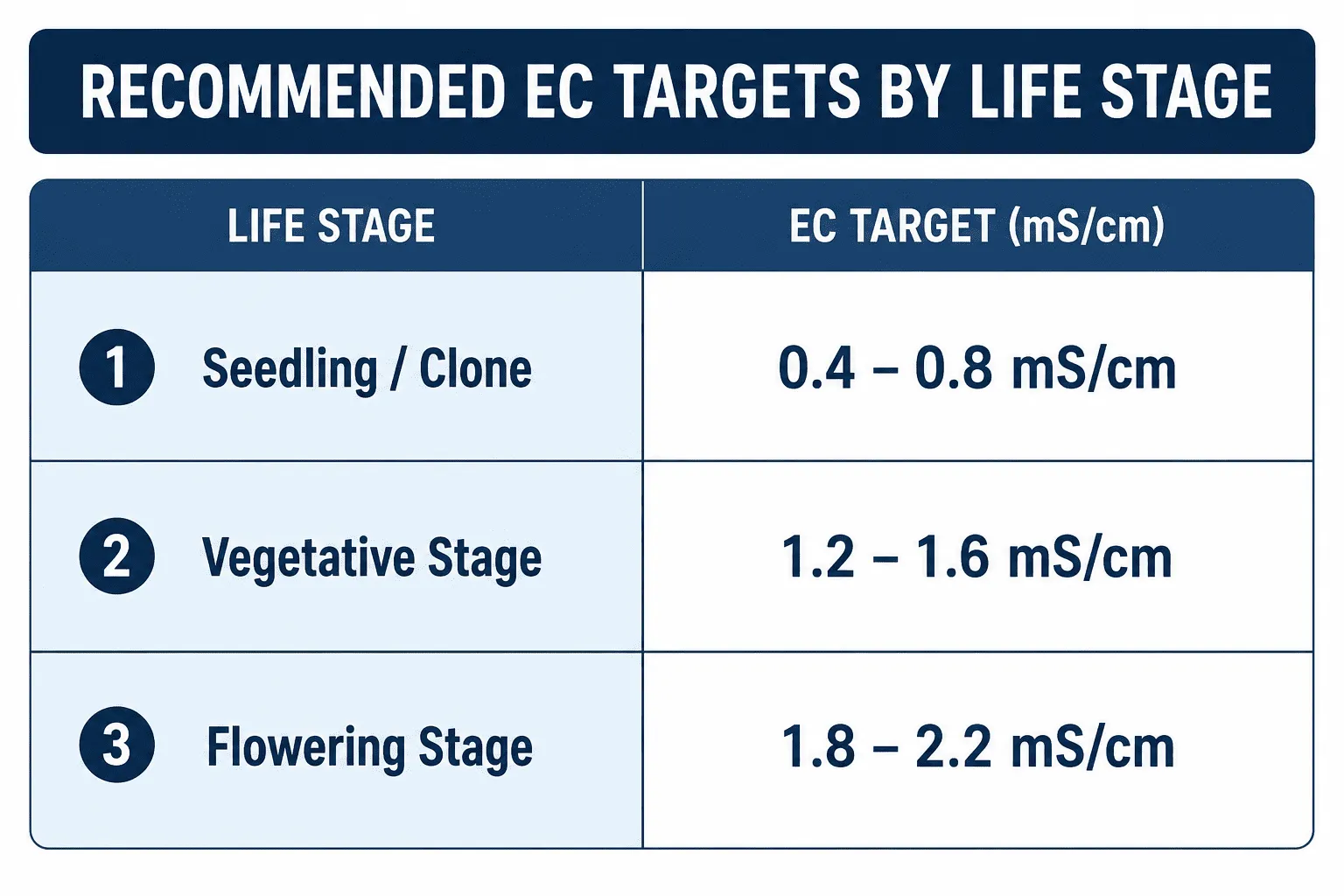
- EC (Electrical Conductivity): Measures the ability of water to conduct an electric current, which increases as mineral salts dissolve. Expressed in millisiemens per centimeter (mS/cm). EC is the universal scientific standard.
- PPM (Parts Per Million): Calculates estimated salt weight. However, meters use different conversion factors (500 scale vs. 700 scale), leading to frequent confusion.
3. Diagnosing Deficiencies: Mobile vs. Immobile
Mobile Nutrients (Nitrogen, Phosphorus, Potassium, Magnesium)
- Nitrogen (N) Deficiency: Lower, older leaves turn pale yellow while top leaves remain green. The plant slowly starves from the bottom up.
- Magnesium (Mg) Deficiency: Interveinal chlorosis occurs on lower leaves—the tissue between leaf veins turns yellow while the veins themselves remain bright green. Fixed with Calcium-Magnesium (Cal-Mag) supplements.
Immobile Nutrients (Calcium, Iron, Sulfur, Boron)
- Calcium (Ca) Deficiency: New leaves emerge twisted or deformed, developing tiny copper-colored spots or dead brown speckles.
- Iron (Fe) Deficiency: Upper leaves turn striking bright yellow/white, but the main leaf veins stay dark green.
Frequently asked questions
Why are my leaf tips turning yellow and dry?
This is a classic sign of "nutrient burn." It happens when the concentration of mineral salts in your feeding solution (EC) is too high. Dial back your bottle dosage by 20–30% and water with plain pH-adjusted water for a few days.
Do I need to flush my plants before harvest?
Flushing involves giving plants only plain water for the final 7 to 14 days before harvest. While heavily debated, it forces the plant to consume stored internal reserves, leading to a smoother burn and cleaner white ash in the final smoked flower.
Authoritative sources
References supporting factual claims and further reading in this guide.