Soil vs. Hydroponics vs. Coco: Best Mediums for Indoor Cannabis
Discover the pros and cons of growing indoor cannabis in soil, coco coir, or deep water culture (hydroponics) to dial in your nutrient management and maximize yields.
Key takeaways
- Match your medium to your lifestyle If you travel or prefer a simple schedule, pick living soil. If you love tracking data and want huge yields, choose coco or DWC.
- Invest in a calibrated pH pen A digital, auto-calibrating pH meter is essential. Color drops or cheap test strips are not accurate enough for indoor growing.
- Don't forget Cal-Mag in Coco Coco coir naturally binds to Calcium and Magnesium ions. Always buffer your coco and supplement Cal-Mag to prevent sudden leaf spotting.
Selecting your growing medium is one of the foundational decisions in indoor cannabis cultivation. The medium determines how roots anchor, how water and oxygen are delivered, and how nutrients are processed by the plant.
Choosing your substrate is just one part of setting up your space; see our master guide on how to grow cannabis indoors to assemble your entire tent.
1. Organic Soil: The Forgiving Classic
Soil cultivation relies on living microbiology to process organic matter into bioavailable plant food. Rather than feeding the plant directly, you feed the soil microbiome, which in turn feeds the roots.- Best For: Beginners, organic purists, and growers seeking maximum terpene density.
- Nutrient Dynamics: High-quality "super soils" or living soils contain pre-amended organic inputs (worm castings, bat guano, kelp meal) that slowly break down.
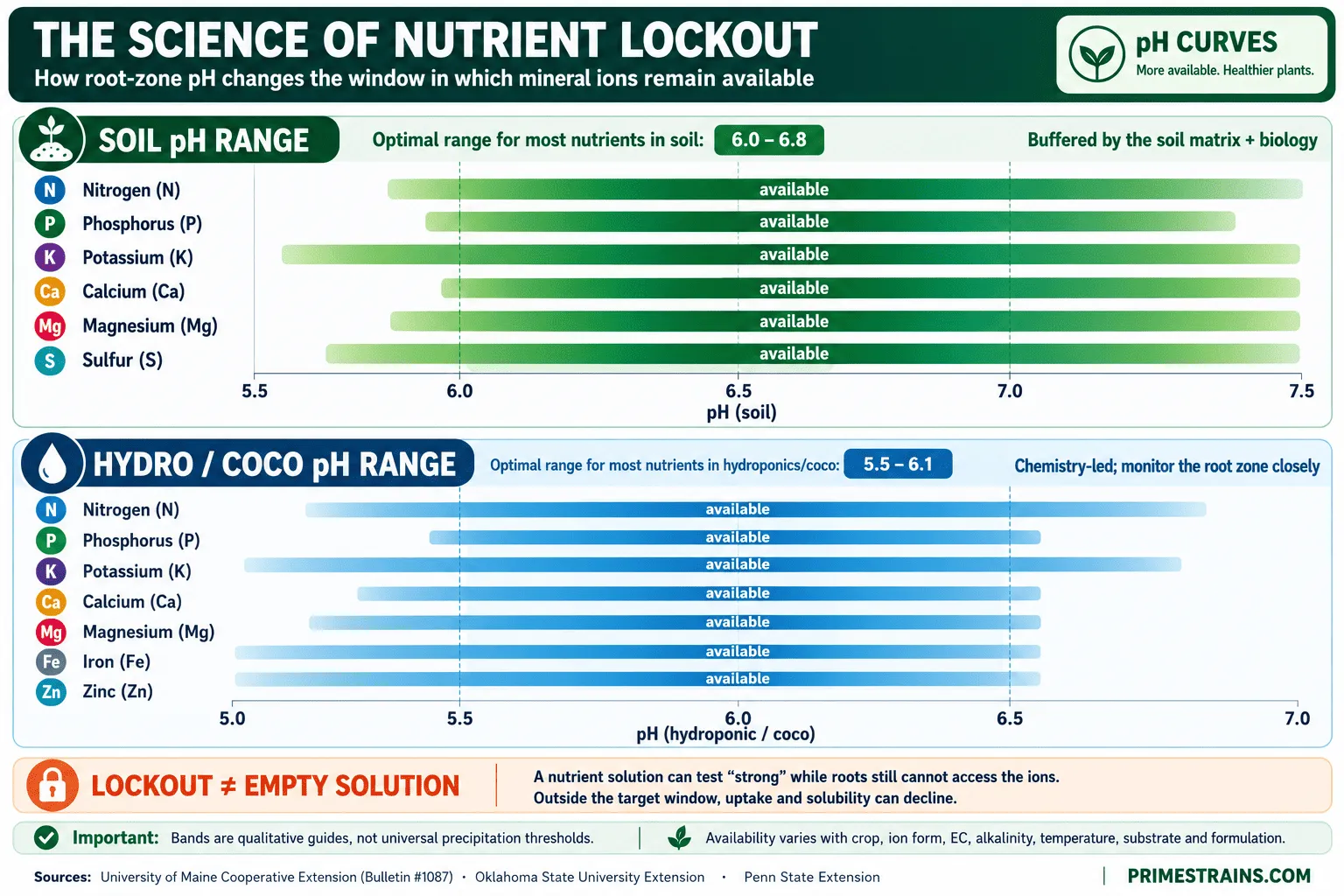
- The pH Range: Aim for 6.0 to 6.8 pH. Soil naturally buffers minor pH fluctuations, protecting plants from sudden nutrient lockout.
2. Coco Coir: Speed Meets Control
- Best For: Intermediate growers wanting faster growth rates without managing complex plumbing.
- Nutrient Dynamics: Coco holds water exceptionally well while maintaining high porosity for root oxygenation. Because it is unamended, you must add liquid hydro nutrients and supplemental Cal-Mag (Calcium & Magnesium) to every watering.
- The pH Range: Maintain a tight window of 5.8 to 6.2 pH.
3. Hydroponics (DWC): Maximum Growth Velocity
- Best For: Advanced growers focused on raw growth speed and maximum biomass per square foot.
- Nutrient Dynamics: Roots consume dissolved oxygen and targeted ionic minerals continuously, resulting in vegetative growth speeds up to 30% faster than traditional soil.
- The pH Range: Target 5.5 to 6.0 pH.
- Risk Profile: High. If water temperatures rise above 68°F (20°C), dissolved oxygen drops rapidly, inviting pathogens like Pythium (root rot).
Growing Medium Performance
| Criteria | Organic Soil | Coco Coir / Hydroponics |
|---|---|---|
| Growth Rate | Moderate (Natural breakdown speed) | Rapid (Direct ionic uptake) |
| Ease of Use | Beginner-friendly (High buffer zone) | Intermediate to Advanced (Requires precise daily monitoring) |
| Nutrient Application | Low frequency (Water mostly, feed occasionally) | High frequency (Every watering includes balanced runoff) |
| Target pH Sweet Spot | 6.0 to 6.8 pH | 5.5 to 6.2 pH |
Maintaining cool water temperatures in hydroponic reservoirs is essential for preventing root rot and fungus gnats.
The Science of Nutrient Lockout & pH Curves
As documented in horticultural literature such as Jeff Lowenfels’ Teaming with Microbes, soil microbes establish a symbiotic relationship with roots, exchanging minerals for exudates. In soil, maintaining a biological food web buffers microbial action, keeping nutrients soluble across a wider range.
In hydro or coco, nutrient availability relies entirely on chemistry. If your solution drops below 5.5 pH, key macronutrients like Calcium and Potassium precipitate out of solution, causing immediate lockout symptoms—even if your nutrient solution is dense with minerals.
Lifecycle Timeline of Cannabis
Cannabis moves through several distinct stages as it grows, with each phase bringing noticeable changes in the plant’s appearance and development. While the exact timing varies depending on genetics, growing conditions, and plant type, a typical lifecycle of cannabis can be broken down into the 4 stages.
Frequently asked questions
Can I mix soil and coco coir together?
Yes, many growers create a 50/50 mix of soil and coco coir to combine the water retention and aeration of coco with the natural microbial buffering of soil.
What causes nutrient burn?
Nutrient burn occurs when the electrical conductivity (EC) of your nutrient solution is too high. The excess salts pull moisture out of the roots, causing leaf tips to dry out, turn brown, and crisp up.
Authoritative sources
References supporting factual claims and further reading in this guide.