Post-Harvest Processing & Resin Preservation: Commercial Drying, Curing, and Solventless Wash Protocols
Master commercial post-harvest processing and resin preservation. Learn how to optimize environmental parameters during drying, curing, and solventless washing to maximize terpene profiles and retail value.
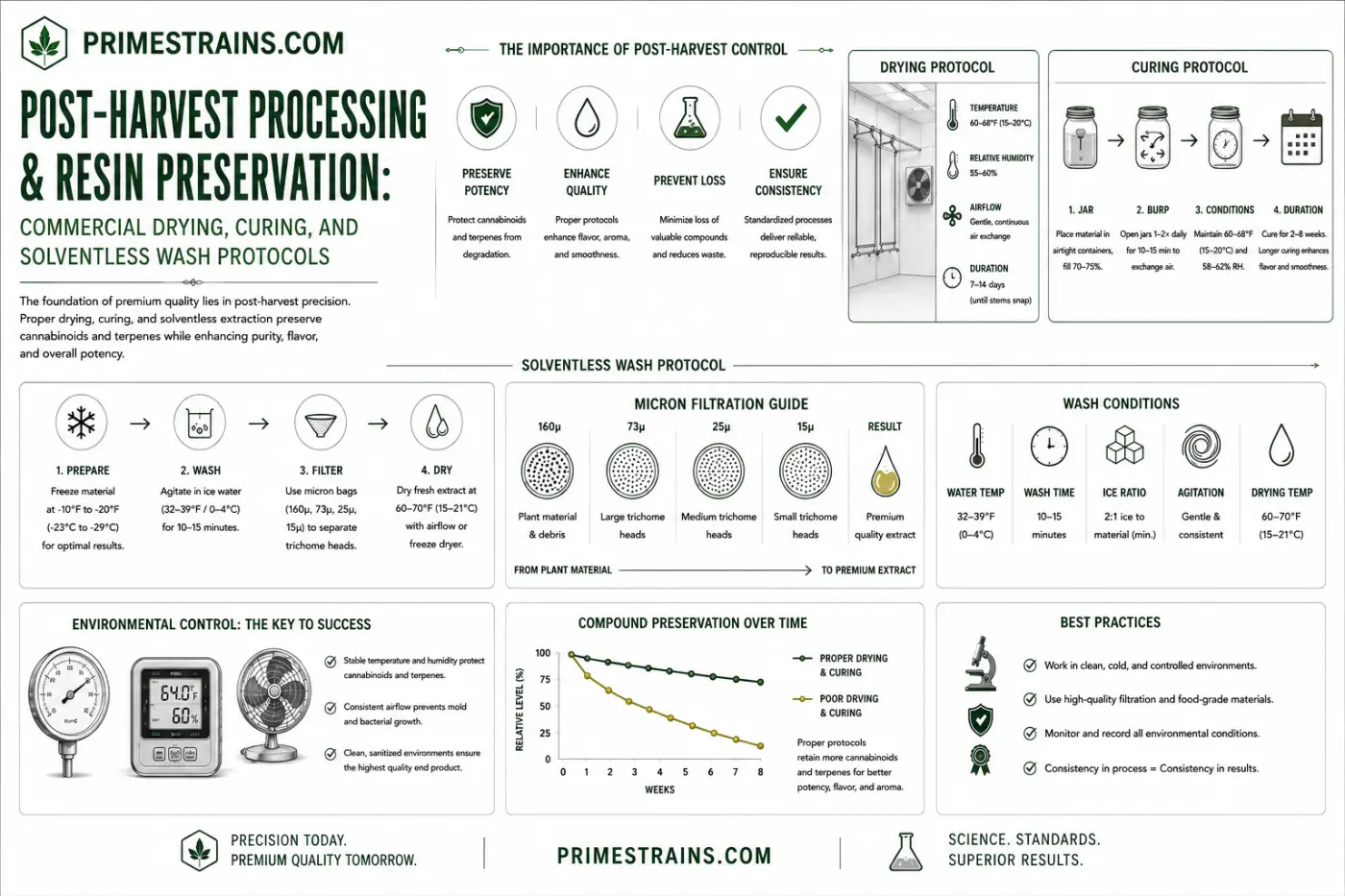
Key takeaways
- Terpene Volatilization Limits Monoterpenes like myrcene, limonene, and pinene begin evaporating at temperatures above 68°F (20°C), making strict room temperature control critical during drying.
- The "60/60" Rule Standard Maintaining a drying room environment of 60°F (15.5°C) and 60% Relative Humidity (RH) over 10 to 14 days preserves essential oil profiles and prevents rapid, uneven moisture loss.
- Water Activity (aw) Target Commercial curing protocols must bring finished dry flower to a target water activity range of 0.55 aw to 0.62 aw to prevent mold proliferation while maintaining ideal flower texture.
- Fresh Frozen Handling For solventless wash operations, harvesting directly into -20°F (-29°C) blast freezers within 30 minutes of cutting preserves monoterpenes and prevents trichome head degradation.
- Trichome Maturity Impact Selecting cultivars based on trichome head size (90um - 120um) and neck brittleness directly dictates solventless extraction yields and wash efficiency.
Cultivating high-yielding, dense canopies is only half the battle. The post-harvest phase—drying, curing, and extraction preparation—is where commercial value is either cemented or destroyed. Improper environmental controls after harvest can result in terpene loss of up to 40%, mold outbreaks, harsh smoke profiles, and degraded cannabinoid purity.
To preserve maximum shelf value and volatile aromatic profiles, commercial facilities must implement precision environmental drying protocols, controlled curing parameters, and data-driven fresh frozen wash workflows.
1. The Physics of Drying: Controlling Moisture & Terpene Loss
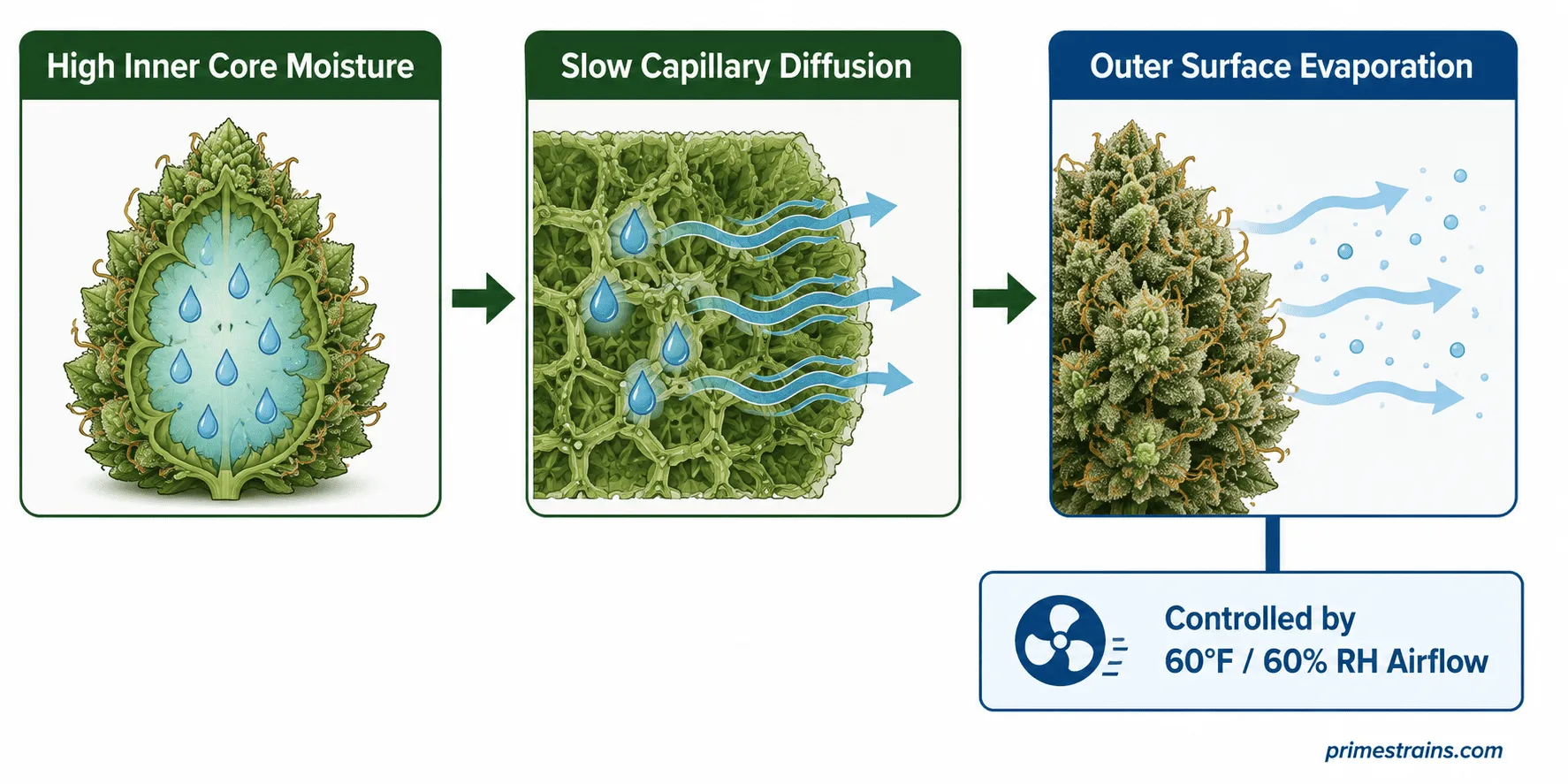
If the drying room RH is too low (<50%), the outer layer hardens ("case hardening"), trapping moisture inside the core and creating ideal conditions for internal mold during curing. If RH is too high (>65%), moisture removal stalls, inviting microbial growth.
Target Environmental Parameters
- Temperature: 58°F - 62°F (14.4°C - 16.6°C)
- Relative Humidity: 58% - 62%
- Airflow Velocity: 0.2 - 0.5 m/s (gentle indirect circulation; never direct high-speed air pointing at drying hanging plants)
- Drying Duration: 10 to 14 days
2. Curing & Water Activity (aw) Optimization
Water Activity (aw) Impact on Flower Quality & Microbial
| Criteria | Optimal Target Zone (0.55 - 0.62 aw) | High Risk Zone (> 0.65 aw) |
|---|---|---|
| Water Activity Range | 0.55 aw - 0.62 aw | 0.65 aw |
| Microbial & Mold Risk | Zero growth risk; completely halts mold and bacterial spores | High pathogen risk; Aspergillus, Botrytis, and Penicillium flourish |
| Terpene & Aroma Retention | Maximum retention of volatile monoterpenes and rich aroma | Rapid degradation and musty off-gassing from microbial activity |
| hysical Flower Texture | Ideal spongeability, flexible calyxes, and resinous stickiness | Soggy, overly wet buds susceptible to internal stem rot |
| Regulatory Compliance | 100% compliant with state and international water activity standards | Immediate failure of state compliance testing for microbial limits |
3. Fresh Frozen Wash Protocols for Solventless Extraction
The Fresh Frozen Workflow
- Precision Harvest: Cut plants under cool room lighting, stripping away large fan leaves that contain low resin and high chlorophyll.
- Immediate Vacuum Bagging: Place trimmed whole buds or untrimmed wet biomass into light-gauge, food-grade bags without over-packing or crushing floral heads.
- Deep Freeze Induction: Move filled bags into a blast freezer at -20°F (-29°C) within 30 minutes of harvest to freeze plant moisture solid and lock in live terpene profiles.
- Immediate Vacuum Bagging: Place trimmed whole buds or untrimmed wet biomass into light-gauge, food-grade bags without over-packing or crushing floral heads.
- Ice Water Extraction: Wash frozen biomass in purified 32°F (0°C} water using micro-bubble agitation to snap brittle trichome heads clean off their stalks without tearing green leaf tissue.
4. Connecting Post-Harvest to Genetic Selection
- Wash-Optimized Phenos: Use data-driven pheno-hunting protocols to identify phenotypes specifically evaluated for high fresh-frozen wash output (>4% return) and large trichome head diameter.
- Canopy Uniformity: Cultivating True F1 hybrid seeds ensures that entire flower bays reach peak trichome maturity simultaneously, simplifying harvest timing and post-harvest scheduling.
- Structural Hygiene: Combining SCROG and pruning techniques prevents low-grade lower foliage from entering the post-harvest pipeline, reducing processing labor.
Frequently asked questions
What is the ideal water activity level for passing state compliance testing?
Most state regulations mandate that dry commercial cannabis flower must maintain a water activity (aw) below 0.65 aw. Operating within the 0.55 aw to 0.60 aw window ensures complete regulatory compliance while preserving product quality.
Why does fresh frozen biomass yield higher terpene levels than dry flower?
Drying exposes flower to air and temperature changes, causing highly volatile monoterpenes (like myrcene and beta-caryophyllene) to evaporate over time. Freezing biomass immediately upon harvest preserves the exact terpene profile of the live plant.
How long can fresh frozen cannabis biomass be stored before washing?
When kept in sealed, food-grade packaging inside a continuous -20°F commercial deep freezer, fresh frozen biomass can be stored for 6 to 12 months without significant loss of trichome head integrity or terpene degradation.
Authoritative sources
References supporting factual claims and further reading in this guide.
- Journal of Cannabis Research (2022) The Impact of Post-Harvest Drying Parameters on Monoterpene Volatilization and Cannabinoid Degradation jcannabisresearch.biomedcentral.com
- ASTM International (D8250 Standard) Standard Practice for Applying Water Activity ($a_w$) Concepts to Cannabis and Hemp Products astm.org