strain reviews

Acapulco Gold: The Golden Landrace That Defined 1960s Counterculture

Acapulco Gold is the legendary Mexican sativa landrace that helped define 1960s and '70s counterculture cannabis — a golden-hued, high-potency strain smuggled north from Guerrero's coastal mountains that became a benchmark for quality decades before "top-shelf" was a category. Here's the real history behind the gold standard.
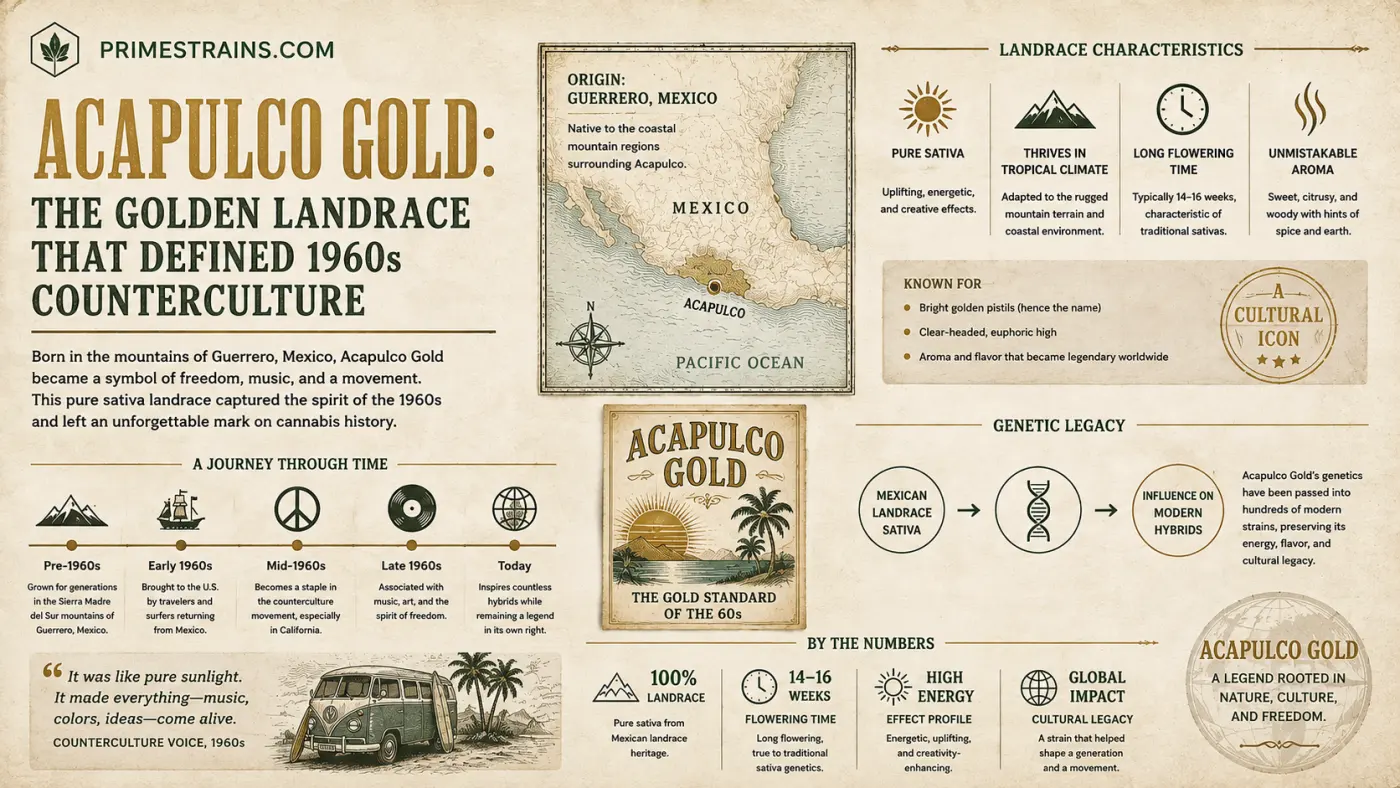
At a glance

Key takeaways

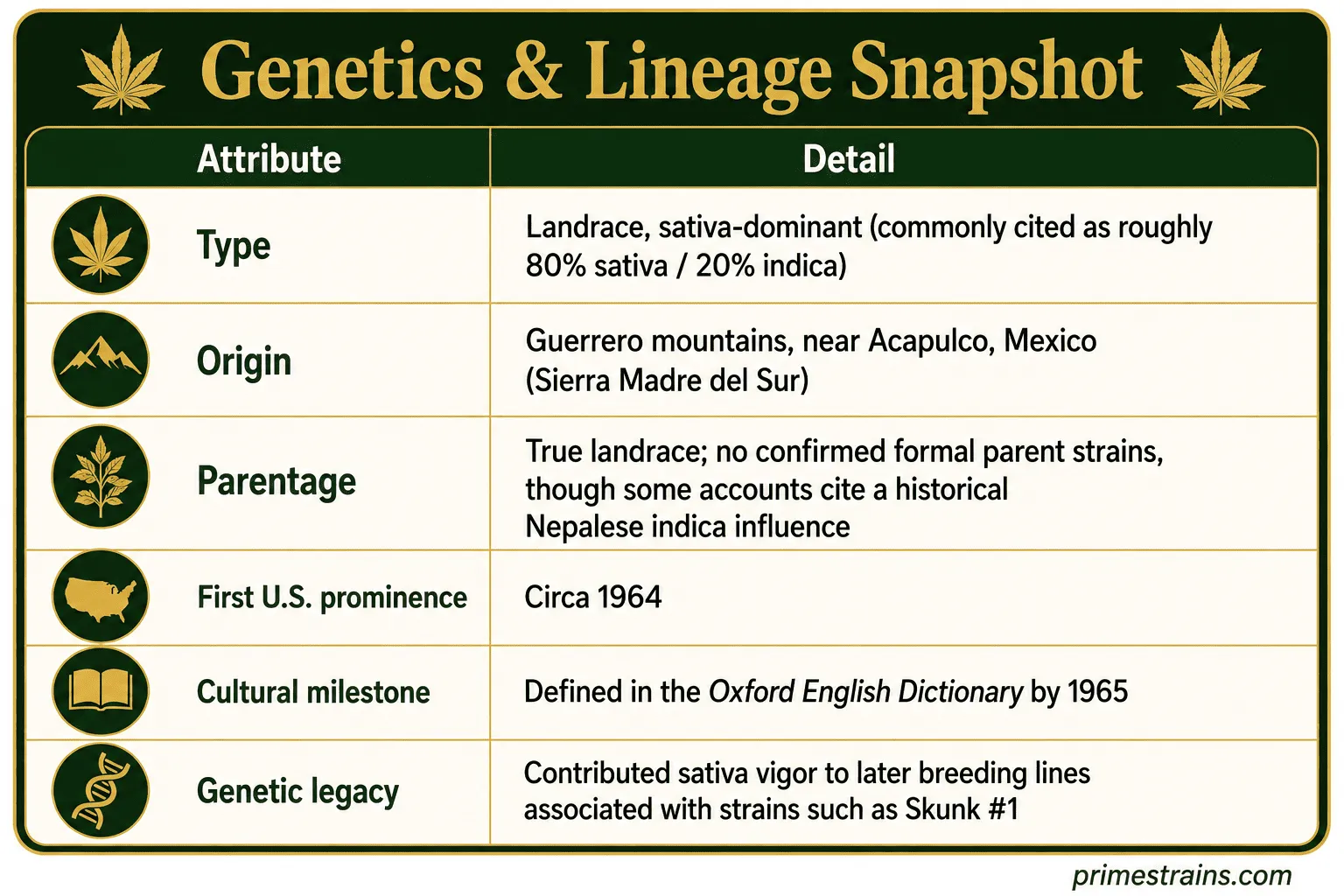
  • Acapulco Gold is a landrace sativa originating in the Guerrero mountains near the Pacific coastal city of Acapulco, Mexico, first gaining fame in the United States around 1964.
  • Its signature golden-amber bud color came from traditional outdoor cultivation and sun/wind-curing on the branch, not from breeding or additives.
  • The strain became so culturally significant that the Oxford English Dictionary added a definition for it in 1965, describing it as a distinct high-grade cannabis type.
  • As a true landrace, Acapulco Gold has no formal parent strains — some sources report a historical cross with Nepalese indica genetics, though most accounts describe it as an unaltered heirloom variety shaped entirely by its native environment.
  • True landrace Acapulco Gold is extremely rare today; nearly all commercial seed available under the name is a stabilized reproduction or modern hybrid rather than original Guerrero stock.

The Origin Story: Guerrero's Golden Mountains

Acapulco Gold traces back to the coastal mountain region of Guerrero, Mexico, in the hills surrounding the resort city of Acapulco on the Pacific coast. Unlike modern hybrids built from documented breeding programs, Acapulco Gold is a landrace — a variety that developed naturally over many generations, shaped entirely by the region's tropical climate, altitude, and soil rather than by deliberate crossbreeding. Most accounts describe it as a pure sativa heirloom with no known parent strains, though a small number of sources report a historical cross between native Mexican stock and a Nepalese indica; either way, by the time it reached American smokers it was already a stabilized, place-adapted variety in its own right.

The strain first made a real impact in the United States around 1964, arriving through the same smuggling and tourism routes that brought other Mexican cannabis north during the era. What set it apart immediately was quality and consistency at a time when most cannabis reaching the U.S. market was low-grade "brick weed" pressed for transport. Acapulco Gold stood out as something closer to a premium product — dense, aromatic, and visually distinct — years before the language of "top-shelf" cannabis existed.

Where the Gold Color Actually Comes From

The defining trait, and the source of the name, is the buds' golden-amber to brownish-gold coloration. Popular legend — often attributed to smuggler-era folklore involving figures like Gary Tovar — credits the Pacific Ocean's coastal winds and the way buds were traditionally dried directly on the branch in Guerrero's intense sun. Modern growers and breeders generally agree the coloration results from a combination of chlorophyll breakdown under strong equatorial sunlight and traditional outdoor curing methods rather than any genetic pigment trait. It's a good example of a landrace expressing traits tied directly to its native growing environment — traits that are notoriously difficult to fully reproduce once a strain is moved indoors or into a different climate.

A Strain Significant Enough for the Dictionary
Few cannabis strains have left a cultural footprint large enough to register outside the cannabis world itself, but Acapulco Gold did. By 1965, the Oxford English Dictionary had added an entry defining it as a distinct, recognized grade of cannabis associated with the Acapulco region and its characteristic brownish-gold coloration — a rare instance of a specific cannabis strain earning formal dictionary recognition during an era when the plant was almost entirely absent from mainstream reference material.
Genetics & Lineage Snapshot
Genetics & Lineage Snapshot.

Appearance, Aroma & Flavor

Authentic Acapulco Gold produces long, slender colas on a tall, stretchy sativa frame, with buds that mature into a distinctive golden-brown to amber hue rather than the deep green typical of most modern strains. Trichome coverage under the right growing conditions can push the coloration toward a shimmering, almost metallic gold.

The aroma and flavor profile is one of the strain's most distinctive features: notes of burnt toffee, roasted coffee, and sweet pine, with a peppery, spicy edge on the exhale driven by caryophyllene — a terpene also responsible for the spice in black pepper. It's a flavor profile unlike most modern fruit- or gas-forward cultivars, and part of why the strain still draws interest from growers chasing heritage genetics.

Effects Profile

Acapulco Gold delivers a classic sativa experience: an energetic, clear-headed, and creatively stimulating high that made it a favorite of the 1960s and '70s counterculture scene. Reported THC levels have historically ranged from roughly 15% to the low-to-mid 20s depending on phenotype and growing conditions — genuinely potent for cannabis of that era, and part of what separated it from the low-grade imported cannabis that dominated the U.S. market at the time.

Growing Info: Quick Facts

  • Flowering time: Roughly 70–77 days, with a long equatorial-style growth rhythm
  • Climate suitability: Best suited to warm, sunny, subtropical climates; struggles to fully express its heritage traits in cooler or shorter-season environments
  • Growth pattern: Tall, slender, and stretchy — original landrace expressions can reach 6–10 feet with long internodal spacing
  • Yield potential: High in the right outdoor conditions, with reports of large single-plant yields in ideal climates
  • Grower difficulty: Challenging, particularly indoors — its size, stretch, and long flowering window make it better suited to outdoor or greenhouse cultivation with room to grow
Growers attempting a modern outdoor run of Acapulco Gold's tall, stretchy structure will get significant value from active canopy control; our guide on SCROG and trellising for yield optimization covers training approaches suited to exactly this kind of vigorous sativa architecture.

Why Landrace History Still Matters

Acapulco Gold is a reminder of what cannabis genetics looked like before controlled breeding programs existed — a plant shaped purely by place, passed hand to hand rather than bred to a documented spec. That informal history is exactly why true original-genetic Acapulco Gold is now so rare, and why most seed sold under the name today is a modern reconstruction rather than the real Guerrero landrace. It's a useful contrast with how far cannabis breeding has come: modern F1 hybrid programs exist specifically to lock in and reliably reproduce desirable traits generation after generation, and techniques like triploid, seedless cannabis breeding represent a level of genetic precision that simply didn't exist when landraces like Acapulco Gold were being passed along informal smuggling routes in the 1960s.

Frequently asked questions

Is real Acapulco Gold still available today?

True original landrace Acapulco Gold is extremely rare. Most cannabis sold under the name today is a stabilized reproduction or modern hybrid bred to approximate the original landrace's traits, rather than genuine unaltered Guerrero stock.

Why is Acapulco Gold gold-colored instead of green?

The golden-amber coloration results from a combination of chlorophyll breakdown under Guerrero's intense equatorial sunlight and traditional outdoor sun/wind-curing methods, not from a specific pigment gene. Reproducing the exact color reliably outside its native growing environment is difficult.

Is Acapulco Gold a sativa or indica?

It's a sativa-dominant landrace, commonly cited as roughly 80% sativa / 20% indica. As a true landrace it doesn't have a formal hybrid breeding lineage the way modern crosses do.

Evidence and further reading

Authoritative sources

References supporting factual claims and further reading in this guide.

  1. Acapulco Gold Traditional heirloom strain of cannabis named for its location of origin (Acapulco) and typical color. en.wikipedia.org